

Why Google Search Console Can’t Be Your Only Data Source
Welcome to the future of data-driven marketing. We are a 360° Digital Marketing Agency. We …


 ★★★★★ 5.0 · 100+ reviews








Table of Contents
MEET OUR TEAM!
The digital marketing industry is always moving. This constant motion demands adaptability and a deep understanding of new technologies. Artificial intelligence changes how consumers interact with information online. Because of this, many businesses wonder if the basic rules of online visibility have completely changed. The truth is much more complex and grounded in the core principles of user experience. To succeed in this new environment, brands need more than just reactive tactics. They need a strategic partner who can cut through the noise. This partner must implement data-driven methods that drive real growth.
Over the past two years, generative artificial intelligence has caused a massive shift in digital marketing. We have seen the rapid rollout of Google’s AI Overviews. We have also witnessed the fast rise of platforms like Perplexity and ChatGPT. Zero-click searches are becoming much more common every single day. This rapid change has caused some panic within the SEO community. Marketers and business owners question whether traditional ranking factors are now obsolete.
However, a close look at the data from 2024 through 2026 reveals a comforting reality. Search algorithms and spam policies do not fundamentally change with AI search. The presentation of results has moved from a simple list of blue links to conversational answers. Yet, the ultimate goal of search engines remains identical. They still want to provide users with the most accurate, helpful, and authoritative information possible.
Understanding why search algorithms and spam policies stay the same requires looking closely at recent updates. Google’s advanced systems are not biased against artificial intelligence. Instead, they are strongly biased against low-quality, manipulative, and unhelpful content. An article might be written entirely by a human. Or, it might be drafted with the help of a Large Language Model (LLM). Either way, the criteria for success rely heavily on Experience, Expertise, Authoritativeness, and Trustworthiness (E-E-A-T).
In this complete guide, we will explore the evolution of search from 2024 to 2026. We will break down the latest spam policies and provide actionable strategies. These strategies will ensure your brand remains visible, authoritative, and influential in the era of AI-driven discovery. We will also explain how to adapt your content for the future.
To fully understand why the core rules of search remain intact, we must analyze the industry statistics over the last 18 months. The introduction of AI Overviews (AIOs) represents the most disruptive change to the Search Engine Results Page (SERP) since featured snippets. Extensive industry studies from late 2025 show that about 57% of traditional searches now trigger an AI Overview. This integration has deeply affected user behavior across the internet.
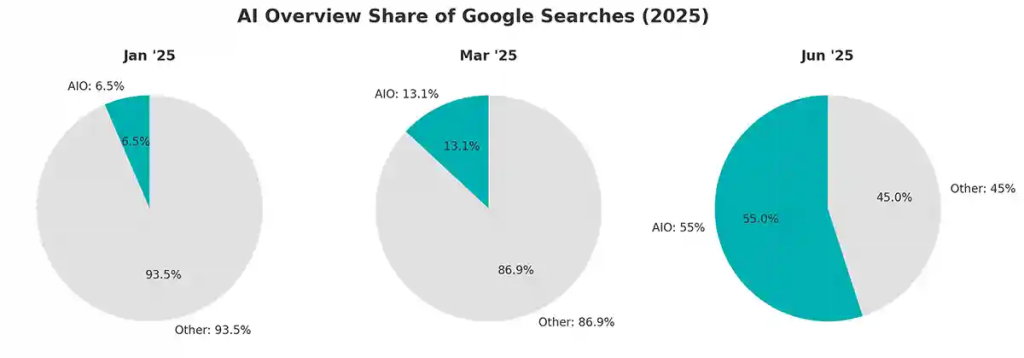
This shift has led to a noticeable drop in clicks to top-ranking organic pages. Data indicates that traditional blue links can lose up to 34.5% of their traffic when an AI summary appears. This pushes the zero-click search rate to nearly 60% for informational queries. Users are getting their answers directly on the results page. They no longer need to click through to a website for basic facts.
Despite these shifting click-through dynamics, Google kept a dominant 89.54% share of the global search market in 2025. This metric is highly important for marketers to understand. It highlights that users are not abandoning traditional search engines. They are simply consuming information differently within them. People still trust Google to find the answers they need.
Furthermore, the spread of AI in content creation is staggering. Recent reports show that a massive 74% of all new web content includes AI-generated elements. Surprisingly, over 86.5% of the content ranking in Google’s top 20 results is at least partially AI-assisted. This data definitively proves that search algorithms and spam policies do not fundamentally change with AI search when it comes to penalizing the tool itself.
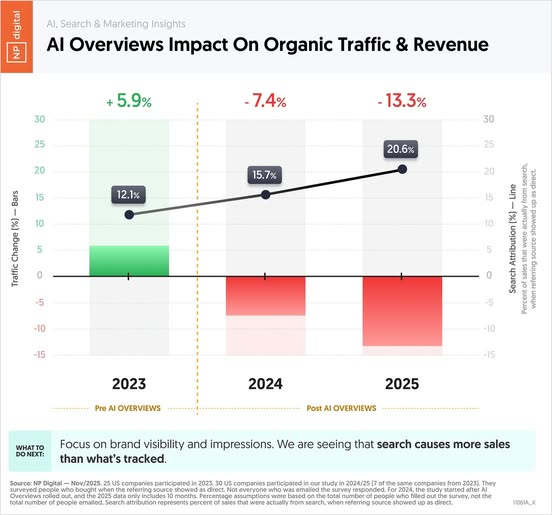
Search engines actively reward high-quality, AI-assisted content. This content just needs to meet their strict quality guidelines and serve the user’s intent. If an AI tool helps you create a better, more accurate article, search engines will favor it. The focus is always on the final value provided to the human reader.
People often say that AI broke SEO entirely. This idea usually comes from a misunderstanding of Google’s major algorithmic shifts. The historic March 2024 Core Update and the August 2025 Spam Update are prime examples. The March 2024 update was a major turning point for the industry. It took 45 days to roll out completely.
This update resulted in a 45% reduction of low-quality, unoriginal content in search results. It integrated the Helpful Content System directly into the core algorithm. Because of this, websites are now continuously evaluated on their usefulness to human readers. They are no longer just periodically assessed during major updates. This constant evaluation forces creators to maintain high standards.
Google’s spam policies were also aggressively overhauled during this period. However, they were not updated to ban AI. Instead, they focused on specific manipulative tactics used to cheat the system. The primary targets included Scaled Content Abuse, Site Reputation Abuse, and Expired Domain Abuse. These tactics ruin the user experience by flooding search results with garbage.
Scaled Content Abuse happens when publishers use automation to generate thousands of low-value pages daily. They do this with no human oversight, purely to manipulate search rankings. Google’s systems, such as SpamBrain, became incredibly good at identifying these patterns. They can easily spot websites that publish massive amounts of text without offering real value.
The policy does not state that AI is spam. It states that using any tool to generate massive amounts of unhelpful content is spam. This distinction is the key to understanding why search algorithms and spam policies do not fundamentally change with AI search. The rule against spamming has always existed. The AI era simply provided spammers with a faster tool, prompting search engines to develop faster detection mechanisms.
Another major pillar of the recent spam policy updates is the crackdown on Site Reputation Abuse. Many people in the industry call this parasite SEO. In 2024 and 2025, Google began heavily penalizing authoritative websites. These included major news publishers or educational institutions that leased out subdirectories to third parties.
The goal of leasing these spaces was to publish unrelated, low-quality content. For example, a reputable medical domain might host a section on the best online casinos. They do this to pass their high domain authority onto spammy content. Search engines quickly realized this tactic was tricking users. They took swift action to devalue these specific subdirectories.
This strict enforcement highlights a vital truth about modern search algorithms. Authority must be earned and it must be topically relevant. You cannot bypass the hard work of building a reputable brand by simply purchasing space on an established domain. Search engines want to see that you are an expert in your specific field.
As AI makes it easier to generate content, search engines look closer at off-page signals. They rely heavily on brand reputation and topical authority to determine rankings. The algorithm is looking for genuine expertise. If a website publishes an AI-generated article about advanced financial strategies, the algorithm checks the facts.
It will cross-reference the author’s credentials, the site’s historical focus, and external citations. The fundamental requirement for trust remains unchanged. This reinforces the reality that search algorithms and spam policies do not fundamentally change with AI search. You still need to prove that you are a reliable source of information.
Some marketers still had lingering doubts about what truly drives search visibility. These doubts were cleared up by one of the most significant events in recent digital marketing history. The unprecedented Google API documents leak provided the industry with a rare look inside. It offered an unfiltered view into the inner workings of the world’s most powerful search engine.
The leaked documentation revealed thousands of potential ranking features. It also confirmed long-held suspicions about how Google values user interaction. Key takeaways from the leak highlighted the immense importance of user engagement metrics. Systems like NavBoost heavily weigh click data, dwell time, and successful search journeys.
The leak also revealed that Google utilizes Chrome browser data. This data helps assess how real users interact with web pages across the internet. What does this mean in the context of AI? It means that no matter how advanced your AI-generated content is, real human beings must click on it. If they do not read it and find it satisfying, it will not maintain its ranking.
The algorithm rewards pages that successfully resolve a user’s query. The leak proved that engagement signals, brand entity recognition, and high-quality backlinks are the true currency of the web. This is the ultimate validation that search algorithms and spam policies do not fundamentally change with AI search. The algorithm still seeks to satisfy the human user, using human behavior as its primary compass.
Digipeak was launched in 2020 as a full-service agency to help companies become influential in the digital world. Being a complete digital marketing agency, we have experienced many successes with our performance-focused approach. We will keep on delivering these exceptional results for our clients. Our online marketing agency takes pride in having a talented and diverse team from all corners of the world.
This multicultural structure enables us to execute successful global campaigns. It also provides a significant advantage in creating creative and original solutions. When we founded Digipeak, we had two things in mind. We wanted constant growth and to make a real impact. Seeing the digital marketing industry lacking in creativity, discipline, and fresh ideas sparked our desire to offer better solutions.
Our mission is to inspire, motivate, and collaborate to guide you on the path to realizing your dreams. We are excited, proud, and happy to be where we are today with you. As your professional partner, we will help you rewrite and share your story. Our stats include over 126 happy clients and an $850,000 marketing budget utilized. We have also developed over 100 websites and completed more than 30 branding projects.
Digipeak Digital Marketing Agency offers a wide variety of specific services to help your business grow. These include Web Design, E-Commerce, SEO, AEO, and ASO. We also handle Digital Ads Management and PPC, Social Media Management, and Content Marketing. Our team excels in E-mail Marketing, Graphic Design, UX/UI Design, and Brand Identity.
We provide Video Production, Photo Production, SaaS Marketing, Fashion Marketing, B2B Marketing, Health Marketing, and AI solutions. Every service is tailored to meet the unique needs of your business. We focus on delivering measurable results that improve your bottom line. Our team stays updated on all the latest algorithm changes to keep your brand ahead of the competition.
The core algorithms remain steadfast in their pursuit of quality. However, the strategies required to surface that quality have shifted. This is where Answer Engine Optimization (AEO) and Generative Engine Optimization (GEO) come into play. AI Overviews and platforms like ChatGPT synthesize information to provide direct answers.
Because of this, marketers must optimize their content to be easily readable by these machine learning models. This involves a shift from merely targeting high-volume keywords. Now, the focus is on targeting complex, conversational queries and long-tail questions. Users are asking full sentences instead of typing fragmented keywords.
To succeed in AEO, content must be structured logically. You need to use clear HTML hierarchies, strong schema markup, and concise answers to common questions. When an AI model scrapes the web to compile an overview, it looks for authoritative sources that present facts clearly. It ignores walls of text that lack clear formatting.
You should implement comprehensive FAQ sections and use bullet points for readability. Ensuring technical Search Engine Optimization (SEO) is flawless is also crucial. These steps increase the likelihood of your brand being cited as a source within an AI-generated response. Being cited in an AI Overview is the new equivalent of ranking in the top three organic spots.
It builds immense brand trust and authority. This is true even if it yields fewer direct clicks than traditional blue links. When users see your brand recommended by an AI, they view you as a top industry expert. This trust eventually leads to higher conversion rates when they do visit your site.
It is a misconception to view AI search and traditional search as completely separate disciplines. In reality, they work together perfectly. The foundational elements of traditional SEO are prerequisites for AI visibility. These include site speed, mobile-friendliness, secure architecture (HTTPS), and solid internal linking.
An AI bot cannot read and synthesize your content if it cannot efficiently crawl and render your website. If your site is broken, the AI will simply move on to a competitor. When comparing AI search vs traditional SEO, the most successful digital marketing campaigns in 2026 blend the two. You must satisfy both the human reader and the machine crawler.
Traditional SEO ensures that your website meets the technical and structural requirements demanded by search engine crawlers. Meanwhile, AEO ensures your content is formatted and contextualized perfectly for Large Language Models. Both strategies are required for maximum online visibility. Ignoring one will severely limit the effectiveness of the other.
Furthermore, AI search platforms often rely on the traditional search index to retrieve real-time information. Maintaining high organic rankings on the standard SERP directly influences your likelihood of appearing in AI Overviews. The fact that traditional ranking factors still dictate AI visibility is further evidence that search algorithms and spam policies do not fundamentally change with AI search.
The barrier to entry for content creation has dropped to near zero thanks to generative AI. Because of this, the sheer volume of information on the internet has exploded. In this sea of automated text, how does a search algorithm determine what is valuable? The answer lies in E-E-A-T: Experience, Expertise, Authoritativeness, and Trustworthiness.
Google has explicitly stated that trust is the most critical component of this framework. To signal E-E-A-T effectively in 2026, brands must go beyond basic content creation. They need to demonstrate real-world experience. This means incorporating original research, proprietary data, expert quotes, and unique perspectives.
An AI cannot simply scrape these elements from existing databases. Author bios must be detailed, linking out to verified social profiles and external publications. This establishes the writer as a recognized entity in their field. Reviews, testimonials, and case studies play a massive role in establishing trustworthiness.
When an algorithm evaluates a page, it looks for these trust signals. It uses them to differentiate between a genuinely helpful resource and a generic, AI-generated summary. AI cannot replicate genuine human experience or earn real-world authority. Therefore, E-E-A-T has become the ultimate differentiator. This proves once again that the core of search algorithms and spam policies do not fundamentally change with AI search.
One of the most major impacts of AI search is the necessary shift in how we measure digital marketing success. For over a decade, the primary Key Performance Indicators (KPIs) for organic search were rankings, impressions, and click-through rates (CTR). These metrics dictated budget decisions and campaign strategies.
However, the rise of zero-click searches and AI Overviews answering user queries directly on the SERP changes things. A singular focus on website traffic is no longer sufficient. Forward-thinking brands and agencies are now tracking “Share of Model Voice” and brand mentions within AI citations. This measures how often an AI recommends your business.
A user might ask an AI platform for the best B2B SaaS marketing strategies. If your agency is cited as a top resource within the chat interface, that is a massive victory for brand awareness. This remains true even if the user doesn’t immediately click through to your website. The goal is to optimize for influence and trust across all platforms.
You should track how often your brand is recommended by AI engines. It is also important to measure engagement metrics on the traffic that does arrive, such as conversion rates and dwell time. By focusing on lead quality rather than just lead quantity, businesses can accurately assess their digital ROI in 2026.
While content and authority are highly important, the technical foundation of your digital presence cannot be ignored. Search algorithms have become increasingly sophisticated at evaluating User Experience (UX) and User Interface (UI) design. A beautiful website is useless if it functions poorly.
Core Web Vitals measure loading performance, interactivity, and visual stability. These metrics remain critical ranking factors. A website that loads slowly, shifts unexpectedly, or provides a poor mobile experience will be penalized. This happens regardless of how expertly its content is crafted. Users will simply leave a slow website.
Furthermore, technical SEO ensures that search engines and AI bots can understand the context of your content. Implementing advanced structured data provides explicit clues about the meaning of a page. This helps algorithms categorize and retrieve your information accurately. It acts as a direct translator for search engines.
For instance, using FAQ schema, Article schema, or Organization schema can significantly boost your chances of being featured in rich results and AI summaries. This technical rigor reinforces the concept that search algorithms and spam policies do not fundamentally change with AI search. The algorithms still require clean, accessible, and structured data to function optimally.
To ensure your website is never caught in the crosshairs of Google’s aggressive spam updates, your content strategy must be unequivocally people-first. The Helpful Content System continuously monitors site-wide quality. If a significant portion of your website consists of low-value, unoriginal pages, it can cause major problems.
This low-quality content can drag down the ranking potential of your entire domain. A winning content strategy in 2026 involves conducting deep audience research. You need to understand the specific pain points, questions, and desires of your target market. You must answer the questions your customers are actually asking.
Instead of publishing ten shallow articles a week, focus on publishing one comprehensive, deeply researched, and highly engaging cornerstone piece. Use AI as an assistant to brainstorm outlines, analyze data, or suggest formatting improvements. However, always rely on human subject matter experts to inject voice, opinion, and real-world facts.
Regularly audit your existing content to update outdated information and consolidate overlapping articles. You should also prune pages that offer zero value. By maintaining a high standard of quality across your entire domain, you align perfectly with the goals of search engines. This proves that ethical, high-quality practices are immune to algorithm volatility.
As we look toward the remainder of 2026 and beyond, the integration of AI in search will only deepen. We anticipate further refinements to Google’s algorithms. These updates will potentially focus even more on multimodal search. This is where users query using images, voice, and text simultaneously.
However, the foundational pillars of digital marketing will remain steadfast. Building a strong, recognizable brand identity will be more important than ever. When users trust a brand, they search for it by name through navigational search. This allows them to bypass generic AI overviews entirely and go straight to your website.
Investing in comprehensive digital marketing solutions creates a complete brand presence that search engines naturally favor. These solutions range from striking graphic design and compelling video production to targeted email marketing and active social media management. All of these elements work together to build trust.
The algorithms are designed to mimic human preference. Therefore, building a brand that humans love is the ultimate SEO strategy. The noise of technological disruption will always be present. However, by focusing on continuous growth, creativity, and genuine impact, businesses can succeed in any digital environment.
The digital ecosystem has undoubtedly been changed by the advent of artificial intelligence. This technology alters the way users seek and consume information. However, the data and algorithmic updates of 2024 through 2026 clearly demonstrate a key fact. The core search visibility mechanics have not been rewritten.
Search algorithms and spam policies do not fundamentally change with AI search. They simply adapt to better identify and reward genuine quality while aggressively filtering out new forms of automated spam. You must prioritize E-E-A-T, embrace Answer Engine Optimization, maintain technical excellence, and focus on user-centric content.
No, Google does not penalize content solely because it is generated by AI. Google’s spam policies target Scaled Content Abuse. This is the practice of generating massive amounts of low-quality, unhelpful content to manipulate search rankings. You can use AI to assist in creating highly valuable, accurate, and user-focused content that demonstrates E-E-A-T. If you do this, your content can perform exceptionally well in search results.
AI Overviews can reduce traditional organic click-through rates. This is especially true for simple informational queries, as users get their answers directly on the search results page. However, being cited as a source within an AI Overview builds significant brand authority and trust. To adapt, businesses must optimize for more complex, long-tail queries. They should focus on Answer Engine Optimization (AEO) to become the authoritative source the AI relies upon.
Search algorithms rely on hundreds of factors. However, the overarching theme of the recent updates and the Google API leak is the critical importance of user engagement and E-E-A-T. This stands for Experience, Expertise, Authoritativeness, and Trustworthiness. Content must satisfy user intent, keep readers engaged, and be backed by an authoritative brand entity. This type of content will consistently outrank shallow, unoriginal text, regardless of how it was produced.

Join the
Digipeak Newsletter!
Stay up to date with the latest digital marketing insights, trends, and updates. Subscribe today!
Related Articles
Welcome to the future of data-driven marketing. We are a 360° Digital Marketing Agency. We …
An in-depth review of top-ranking articles in the USA and the UK reveals a news-oriented …
The digital marketing world moves incredibly fast. Search engines constantly update their algorithms, crawling methods, …

The era of "ten blue links" is effectively over. If you are reading this, you …


