
Attribution Models That Work for B2B Brands
To get a handle on today's marketing, we need to understand the world we're in. …


 ★★★★★ 5.0 · 100+ reviews








Table of Contents
MEET OUR TEAM!
The digital marketing environment has experienced a massive shift over the last eighteen months. This change fundamentally alters how brands connect with their target audiences. Artificial intelligence continues to change search behaviors. Traditional metrics that once defined online success are rapidly becoming obsolete.
Marketers are no longer just competing for the top spot on a search engine results page. They are battling for direct citations within AI-generated responses. Managing this new terrain requires a deep understanding of emerging analytics and tracking methods. Mastering visibility in this zero-click era is crucial. It helps any business aiming to sustain growth, authority, and measurable revenue generation.
Welcome to the new frontier of digital discovery. Large language models (LLMs) and generative AI have redefined user search intent. In 2026, consumers no longer scroll through pages of blue links to find solutions. Instead, they engage in conversational queries with platforms like ChatGPT, Perplexity, and Google AI Overviews.
Users expect immediate, synthesized, and highly accurate answers. This shift has created Answer Engine Optimization (AEO). AEO is a critical discipline focused on structuring your digital content. It ensures AI systems retrieve, trust, and cite your brand as the definitive source.
However, executives and stakeholders want to know how to prove its financial value. This is exactly why measuring ROI for AEO is the most critical conversation in modern marketing boardrooms. Traditional Search Engine Optimization (SEO) relied heavily on tracking organic traffic, keyword rankings, and click-through rates.
AEO requires an entirely different analytical framework. Recent data from early 2026 reveals that nearly 78% of informational queries now result in a zero-click experience. The user receives their answer directly on the results page without ever visiting your website. If your brand is cited in that AI-generated answer, you achieve a massive victory in brand awareness and authority.
But how do you track that success in Google Analytics? How do you assign a monetary value to an AI citation? Throughout this comprehensive guide, we will break down the complexities of AEO attribution. We will explore the vital metrics you need to track. We will also cover the tools required to capture elusive AI referral data and share the specific dashboard configurations that connect your AEO efforts directly to your bottom line.
To truly appreciate the need for advanced AEO dashboards, we must examine structural changes in online information consumption. For over two decades, the contract between search engines and content creators was simple. Creators provided high-quality information, and search engines provided traffic in the form of clicks. Today, generative AI has rewritten that contract.
Platforms like Gemini, Claude, and Copilot operate as answer engines. They ingest vast amounts of web data, synthesize it, and deliver a tailored response to the user. According to recent industry reports, the click-through rate for the number one organic search result dropped by an astonishing 64% over the past year when an AI overview was present.
This does not mean SEO is dead. It means SEO has evolved into the foundational layer upon which AEO is built. You still need technical excellence, rapid site speed, and a flawless mobile experience. However, to win in 2026, your content must also be optimized for machine extraction.
This involves using advanced Schema.org markup. You must maintain crystal-clear entity relationships. Formatting content in logical, question-and-answer structures helps LLMs easily parse the data. When you achieve this, your content becomes a trusted data node for AI systems.
The challenge is no longer just driving traffic. It is measuring the impact of being the authoritative voice in an AI’s response. This is the core challenge addressed by measuring ROI for AEO.
Attempting to measure AEO using traditional SEO dashboards will only lead to frustration and inaccurate reporting. AI search introduces a highly subjective, conversational element to user discovery. Therefore, your measurement strategy must be multi-dimensional.
Analytics experts have identified that a successful AEO reporting model is built upon four connected layers: Visibility, Traffic, Quality, and Attribution. By understanding and tracking each of these layers, brands can paint a complete picture of their AI search performance.
The foundation of any AEO strategy is visibility. In the world of AI search, visibility is defined by how often your brand, product, or content is explicitly cited. This is often referred to as your Share of Voice in LLMs.
Unlike traditional rank tracking, AI responses can vary wildly. They change based on the user’s prompt history and conversational context. Tracking visibility requires specialized tools. These tools run thousands of test prompts across various AI platforms to determine your citation frequency. High visibility means the AI trusts your brand as a primary source of truth for your specific industry entities.
While zero-click searches are rising, AI platforms still drive highly qualified traffic. Websites that successfully optimize for AEO have seen AI-referred sessions grow exponentially. The key to measuring this layer is capturing the referral signals.
Platforms like Perplexity and ChatGPT often include source links in their responses. When users click these links, they are expressing high intent. Tracking this traffic requires meticulous configuration of custom UTM parameters. You also need referral exclusions in your analytics platforms to differentiate an AI-driven visitor from a standard organic search visitor.
Not all traffic is created equal. One of the most fascinating trends observed in 2026 is that visitors arriving via AI citations tend to have significantly higher engagement rates. The AI has already answered their preliminary questions. Users who click through to your site are usually deeper in the marketing funnel.
They are seeking advanced details, pricing, or direct contact. In this layer, your dashboard must track specific metrics. Monitor dwell time, pages per session, and micro-conversions like whitepaper downloads or newsletter sign-ups. Track these specifically for your AI-segmented traffic.
Take Advantage of Automation with Artificial Intelligence!
How can you use your time more efficiently? Artificial intelligence saves you time by automating repetitive tasks. Learn how you can leverage AI to accelerate your business processes.
The final and most crucial layer is connecting your AEO efforts to actual business revenue. This makes AEO ROI defensible to stakeholders. Attribution in AEO often requires multi-touch models. An AI citation might be the first touchpoint in a long B2B buyer journey.
Integrate your AEO visibility data and AI traffic segments directly into your Customer Relationship Management (CRM) software. You can track how many closed-won deals were influenced by an initial discovery via an answer engine. This definitive link between AI visibility and pipeline generation is the ultimate goal of modern digital marketing analytics.
To successfully execute your strategy, you must populate your analytics platforms with the right data points. Relying on outdated metrics will obscure the true value of your generative engine optimization. Below are the essential metrics that must be front and center on your AEO reporting dashboards.
First, you must track AI Citation Frequency. This metric quantifies the absolute number of times your brand or website is referenced across target LLMs for your core query bank. It is the most direct indicator of your content’s extractability and authority.
Alongside frequency, you should monitor Citation Sentiment and Context. It is not enough to simply be mentioned. You must ensure the AI is framing your brand positively and accurately. Advanced AEO tools use natural language processing to score the sentiment of the AI’s response regarding your brand. This alerts you to potential PR issues or AI hallucinations that need correcting.
Another critical metric is Return on Content Investment (ROCI). In the context of AEO, ROCI compares the financial cost of producing and maintaining highly authoritative content against the business value generated by AI citations and subsequent conversions. To calculate this, you must assign a monetary value to different types of AI interactions.
For example, a direct citation in a commercial query on Perplexity might be weighted higher than a brand mention in a broad informational query on ChatGPT. Track the cost of your AEO campaigns against these weighted values. This helps you definitively prove the financial viability of your strategy.
Knowing what to measure is only half the battle. The other half is technically configuring your systems to capture this elusive data. Building an effective AEO dashboard requires a hybrid approach. It blends traditional analytics platforms with cutting-edge AI visibility tools.
The cornerstone of your traffic measurement will likely remain Google Analytics 4 (GA4). However, it requires significant customization to function effectively for AEO. To capture AI referral traffic in GA4, you must create custom channel groupings and audience segments.
Platforms like ChatGPT and Claude often strip traditional referral data. You must rely heavily on custom UTM parameters for any links you can control. This includes links embedded in digital PR campaigns or optimized affiliate placements.

For organic AI citations, you must set up regular expressions (RegEx) in GA4. This captures known AI referral strings, such as android-app://com.openai.chatgpt or referral sources containing ‘perplexity’. Isolating this traffic into a dedicated AI Search channel group lets you compare its performance directly against traditional organic search and paid media.
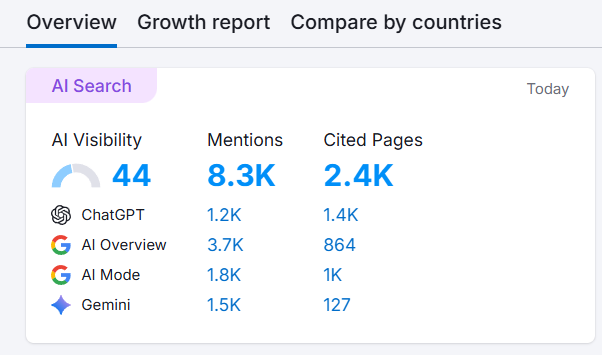
However, GA4 cannot track zero-click visibility. For this, you must integrate specialized AEO platforms into your tech stack. Tools like Semrush AIO, AirOps, and Similarweb’s AI Brand Visibility platform are essential.
These platforms automate the process of running thousands of prompts across various LLMs. They track your brand’s citation share and identify topic gaps where competitors are outperforming you. The ultimate AEO dashboard utilizes APIs to pull the visibility data from these specialized tools. It overlays it with the traffic and conversion data from GA4 and your CRM, creating a single, unified view of your AI search performance.
Proving the financial impact of your AEO strategy requires a structured mathematical approach. Executive boards do not invest in visibility alone. They invest in pipeline growth and revenue generation. Therefore, your dashboards must automatically calculate the ROI of your AEO efforts using a standardized formula.
The basic calculation is the AEO ROI formula: AEO ROI = (Gain from AEO Investment – Cost of AEO Investment) / Cost of AEO Investment. While the formula is simple, defining the variables requires precision.
The Cost of AEO Investment should include the cost of specialized AEO tracking tools. It also includes the hours spent by internal teams or agencies on entity optimization and schema markup. Do not forget the budget allocated for digital PR and authority-building campaigns.
The Gain from AEO Investment is more complex. It must include direct revenue from conversions attributed to AI referral traffic. However, it must also account for Assisted Deal Paths.
Utilize multi-touch attribution models in your CRM. This allows you to assign partial revenue credit to AI citations. These citations often serve as the initial discovery point for a customer who later converts via a direct brand search or an email campaign. Additionally, advanced marketing teams often assign a proxy value to zero-click brand impressions. They calculate the equivalent cost if they had to purchase those impressions via traditional paid search (PPC).
One of the most important discoveries in the evolution of AEO is the undeniable influence of Public Relations and earned media on AI visibility. Traditional search engines rely heavily on the volume of backlinks. LLMs prioritize the quality, context, and factual consensus of external sources.
According to industry analyses, a staggering 82% of links cited by AI engines originate from earned media sources. This includes journalistic coverage, authoritative industry blogs, and established review platforms. This means that your AEO dashboard must also track your digital PR efforts.
Track metrics such as brand sentiment in third-party publications and the frequency of executive quotes in industry news. The volume of high-authority unlinked brand mentions is also a leading indicator of future AI visibility. Answer engines are designed to mimic human research, which means they look for consensus.
If multiple high-authority domains agree that your software is the best in its category, the AI will confidently state that as a fact in its responses. This deep integration of PR highlights the importance of Google E-E-A-T (Experience, Expertise, Authoritativeness, and Trustworthiness) guidelines.
Demonstrating real-world expertise through author bios, verified data points, and transparent sourcing is no longer just good practice. It is a technical requirement for inclusion in the training data of tomorrow’s LLMs.
Implementing these advanced dashboards and shifting your focus toward AI visibility requires a fundamental restructuring of your digital marketing team’s workflows. Content creators can no longer write purely for human entertainment. They must structure their writing with clear headings, concise factual summaries, and logical entity relationships that machines can parse.
Technical SEOs must shift from merely fixing crawl errors to managing complex knowledge graphs and deploying advanced schema markup. For organizations looking to internalize these capabilities, transitioning from SEO to AEO in-house requires comprehensive training and a shift in KPIs.
Teams must be evaluated not just on the traffic they generate. They must also be judged on the citation share they secure and the accuracy of the information the AI retrieves about the brand. This cultural shift within the marketing department is essential for executing a successful strategy. It requires breaking down the silos between the SEO, PR, and content teams, unifying them under the shared goal of dominating the generative search space.
Managing the complexities of Answer Engine Optimization, configuring advanced analytics dashboards, and executing multi-channel digital strategies can be overwhelming. This is true even for the most sophisticated internal teams. This is where partnering with a visionary agency becomes your most significant competitive advantage.
Digipeak was launched in 2020 as a full-service agency to help companies that want to be influential in the digital world. Being a 360° Digital Marketing Agency, we have experienced a number of successes with our performance-focused approach and will keep on doing so. Our online marketing agency takes pride in having a talented and diverse team from all corners of the world.
This multicultural structure not only enables us to execute successful global campaigns but also provides a significant advantage in creating creative and fresh solutions. When we founded Digipeak, we had two things in mind: constant growth and making an impact. Seeing the digital marketing industry lacking in creativity, discipline, and fresh ideas sparked our desire for solutions.
Our mission is to inspire, motivate, and collaborate to guide you on the path to realizing your dreams. We are excited, proud, and happy to be where we are today with you. As your professional partner, we will help you rewrite and share your story.
Our stats include: 126+ Happy Clients, $850,000+ Marketing Budget utilized, 100+ Websites Developed, and 30+ Branding Projects developed. What services Digipeak Digital Marketing Agency specifically offers: Web Design, E-Commerce, SEO, AEO, ASO, Digital Ads Management and PPC, Social Media Management, Content Marketing, E-mail Marketing, Graphic Design, UX/UI Design, Brand Identity, Video Production, Photo Production, SaaS Marketing, Fashion Marketing, B2B Marketing, Health Marketing, AI.
By using our comprehensive suite of services, your brand can seamlessly integrate traditional marketing efforts with cutting-edge AI visibility strategies. This ensures that every dollar spent is tracked, measured, and optimized for maximum return on investment.
Optimizing for platforms like ChatGPT and Google AI Overviews is crucial. However, a truly complete digital strategy recognizes that users search for information across many ecosystems. For brands with mobile applications, the principles of AEO must be aligned with App Store Optimization (ASO).
Answer engines synthesize web data to recommend products. Similarly, app store algorithms synthesize user reviews, keyword relevance, and engagement metrics to recommend applications. Ensure your brand messaging, entity definitions, and core value propositions are consistent across your website, your PR footprint, and your app store listings.
This creates a unified brand identity that algorithms across all platforms can trust and promote. Furthermore, as AI continues to integrate into specialized verticals, the need for bespoke Answer Engine Optimization services will only grow.
Whether you are in SaaS marketing, health marketing, or B2B commerce, the specific LLMs your customers use will vary. The data sources those LLMs trust will also differ. A tailored AEO strategy ensures that your brand is positioned as the authoritative answer within the specific AI ecosystems most relevant to your target audience. This drives high-intent, highly qualified leads directly into your sales pipeline.
As we look toward the remainder of 2026 and beyond, the pace of advancements in artificial intelligence shows no signs of slowing. Search engines will continue to evolve into proactive digital assistants. They will anticipate user needs and deliver synthesized answers before a traditional query is even typed.
In this environment, successful brands will treat their digital content differently. They will not view it as a collection of web pages, but as a structured, accessible database of knowledge ready to be queried by machines.
Implementing these frameworks is not a one-time project. It is an ongoing operational commitment. You must establish structured refresh cycles for your content. Continuously monitor your citation share against emerging competitors.
Refine your attribution models as AI platforms introduce new features and referral mechanisms. Maintain a relentless focus on data accuracy, entity authority, and comprehensive analytics. You can turn the disruption of AI search from a threat to traffic into a massive opportunity for market domination.
To truly master AEO measurement, advanced marketing teams are adopting strategic frameworks to guide their dashboard creation and data analysis. One highly effective model is the FIFI framework: Find, Implement, Fix, and Iterate. This methodology ensures that your AEO dashboards are not just passive reporting tools, but active drivers of marketing strategy.
Find: Your dashboard must identify the high-value conversational prompts your target audience is using. By integrating search intent data with AI query logs, you can pinpoint exactly what questions users are asking LLMs regarding your industry.
Implement: Once the questions are identified, your dashboard should track the deployment of structured answers across your digital properties. Are your FAQ schemas correctly implemented? Are your entity relationships clearly defined?
Fix: The dashboard must highlight areas where your brand is being omitted from AI responses. It should also flag where the AI is hallucinating incorrect information about your products. This allows for rapid PR and content interventions.
Iterate: Finally, the dashboard tracks the impact of your fixes over time. It measures the incremental growth in your citation share and the subsequent lift in pipeline revenue. This continuous loop ensures your AEO strategy remains agile and effective in a rapidly changing technological space.
Despite the advanced tools available, measuring AEO ROI is not without its challenges. One of the most significant hurdles is the black box nature of many large language models. Traditional search engines provide detailed search console data. AI platforms often obscure the exact algorithms and weighting mechanisms they use to select citations.
This lack of transparency means marketers must rely heavily on correlation rather than perfect causation. For instance, you might launch a major digital PR campaign and secure placements in top-tier industry publications. You may see a corresponding spike in your AI citation frequency two weeks later.
You cannot definitively prove that the LLM updated its weights based specifically on those PR links. However, the correlation is strong enough to justify the investment. To mitigate these attribution challenges, your dashboards must embrace multi-touch, weighted models.
Analyze macro trends, such as the relationship between total branded search volume, direct website traffic, and your overall AI visibility score. This helps you build a defensible business case for your AEO budget, even without perfect, click-by-click attribution.
The shift from traditional search to generative AI discovery represents the most significant change in digital marketing in over two decades. As zero-click searches dominate the industry, the old metrics of success are giving way to a new era of analytics. This new era focuses on citation share, brand authority, and multi-touch pipeline attribution.
Mastering the measurement of ROI for AEO is no longer an optional advanced tactic. It is a fundamental requirement for any brand that wishes to remain visible, relevant, and profitable in 2026 and beyond.
Understand the four connected layers of AEO measurement. Configure your GA4 and specialized tools to capture AI referral signals. Mathematically connect your visibility efforts to actual revenue generation. This allows you to confidently invest in the future of search.
While multiple metrics are important, AI Citation Frequency (or Share of Voice in LLMs) is the most critical foundational metric. It measures how often your brand or content is explicitly referenced as a source in AI-generated answers across platforms like ChatGPT, Perplexity, and Google AI Overviews. Without visibility and citations, you cannot drive downstream metrics like AI referral traffic or revenue attribution.
Tracking AI traffic requires a combination of customized Google Analytics 4 (GA4) setups and UTM parameters. Some AI platforms strip traditional referral data. You should append custom UTM tags (e.g., ?utm_source=chatgpt&utm_medium=ai-answer) to links you control. Additionally, you must configure GA4 with custom channel groupings and RegEx rules. This captures known AI referral strings, isolating this traffic to analyze its specific engagement and conversion rates.
Traditional SEO tools are generally insufficient for measuring AEO performance. They are designed to track static keyword rankings and traditional click-through rates. AEO requires specialized platforms that utilize APIs to run thousands of test prompts across various LLMs. They dynamically track your brand’s citation share, sentiment, and visibility in conversational, zero-click environments.

Join the
Digipeak Newsletter!
Stay up to date with the latest digital marketing insights, trends, and updates. Subscribe today!
Related Articles
To get a handle on today's marketing, we need to understand the world we're in. …
Picture a stock exchange. Instead of trading company shares, you're trading chances to grab a …

To grasp why Inventory Velocity is a vital component for success, we must first set …
The B2B growth landscape isn’t just about having the best tools; it’s about having the …


