
How to Increase Mobile App Retention (2026 Guide)
There is a brutal piece of math behind every paid user acquisition budget. Teams that …


 ★★★★★ 5.0 · 100+ reviews








Table of Contents
MEET OUR TEAM!
The most expensive mistake in subscription app growth is killing a channel on day one. A healthy subscription app typically shows a first-day ROAS in the 0.8x to 1.5x band, and the same app reaches 3x to 5x by D90 (Moburst measurement data). Teams that decide which channel works in the first week are systematically killing their most profitable channels before the payback window even opens. The subscription economy runs on delayed returns, and reading it on day-one numbers is like judging a marathon by the first 400 meters.
Subscription app growth is the practice of orchestrating a portfolio of acquisition channels against payback period, paywall economics, and per-channel learning rather than hunting for a single winning channel. Per Adapty’s State of In-App Subscriptions 2026 report, drawn from more than 16,000 apps generating over $3 billion in subscription revenue, the picture is clear: this is a game won by teams that synchronize the learning loop between payback period, paywall design, and channel, not by teams that find one magic channel. Fewer teams get this math right than you would think; the median new launch produces roughly 25 percent less revenue than comparable apps built a few years earlier.
This guide leads with the payback-period discipline, because it is the lens that makes every channel decision correct or wrong, then moves to the five-channel hierarchy, the tactics that shorten payback, the “fix the channel or the paywall first” question, stage-based portfolio scenarios, and how to measure channel performance honestly. By the end you will have a framework to rebuild your channel mix against your own LTV-to-CAC ratio.
Channel selection for a subscription app has changed structurally over the last three years, driven by five forces that each directly affect your channel hierarchy.
Attribution maturity. ATT opt-in has stabilized around 29 percent globally (AppsFlyer 2026 State of Mobile). In an environment where 71 percent of iOS users cannot be tracked deterministically, channel comparison has to rest on cohort-based mobile-measurement-partner reading rather than platform reports. We live in a world where a platform-reported 5.0x ROAS sits next to a measurement-partner-reported 3.2x for the same campaign, and teams that know which number is real produce 30 to 50 percent better ROAS than teams deciding on the wrong one.
Payback-period focus. Healthy CAC recovery for B2C subscription apps runs 4 to 5 months, and 8 to 9 months for B2B. A payback beyond 12 months means either the wrong users are being acquired or there is a structural monetization problem. Shortening that window is far more than a channel-selection question: the free-trial format on the first paywall, the trial-to-paid rate, and onboarding speed are all direct determinants.
Paywall economics moving to center. Per Adapty 2026, onboarding paywalls with a trial produce the highest conversion of any setup at around 1.78 percent, and a weekly-plan-plus-trial combination produces about 1.5 times the average LTV of other setups. Of two apps acquiring the same user from the same channel, the one with better paywall design can produce twice the LTV, which makes channel choice far less decisive than it looks.
Channel saturation. Paid-social CPMs rose sharply through 2025 (roughly 19 percent year over year on the largest platform, per EMARKETER). No single channel can scale past roughly $100,000 per month while holding target CAC in 2026. Every channel has a saturation point; the critical skill is recognizing it and having the next channel’s onboarding scheduled before you hit it.
Web paywalls entering the mix. Since mid-2025, web paywalls have become an alternative to in-app purchase in the US. In-app conversion runs about 1.60 percent against web at 1.10 percent, but web bypasses the app stores’ 30 percent commission. Web paywalls lead on M1 retention (64.5 percent versus in-app 46.2 percent) but the two reverse by M6. Web-to-app funnel design is one of 2026’s fastest-growing tactics, and it is a channel-strategy decision as much as a monetization one.
When these five forces combine, “which is the best subscription app channel” becomes the wrong question. The right one is: in what order, and against which payback periods, should I build my channel portfolio?
| Peaker Note: Killing a Channel Early Is the Most Expensive Mistake On a B2C meditation subscription app Digipeak took over, the first thing we saw in week one was that the previous team had shut off a paid-social campaign with a D7 ROAS of 0.3x, calling it “not working.” In cohort analysis, that same campaign reached 2.8x ROAS by D90, because in meditation apps the majority of subscription conversions land between day 30 and day 60. Teams that set the payback window correctly can keep campaigns that look bad open long enough to become profitable; teams that do not kill their most profitable campaigns. In a subscription app, wait for at least the D30 cohort ROAS before pausing a campaign, and D60 where possible. |
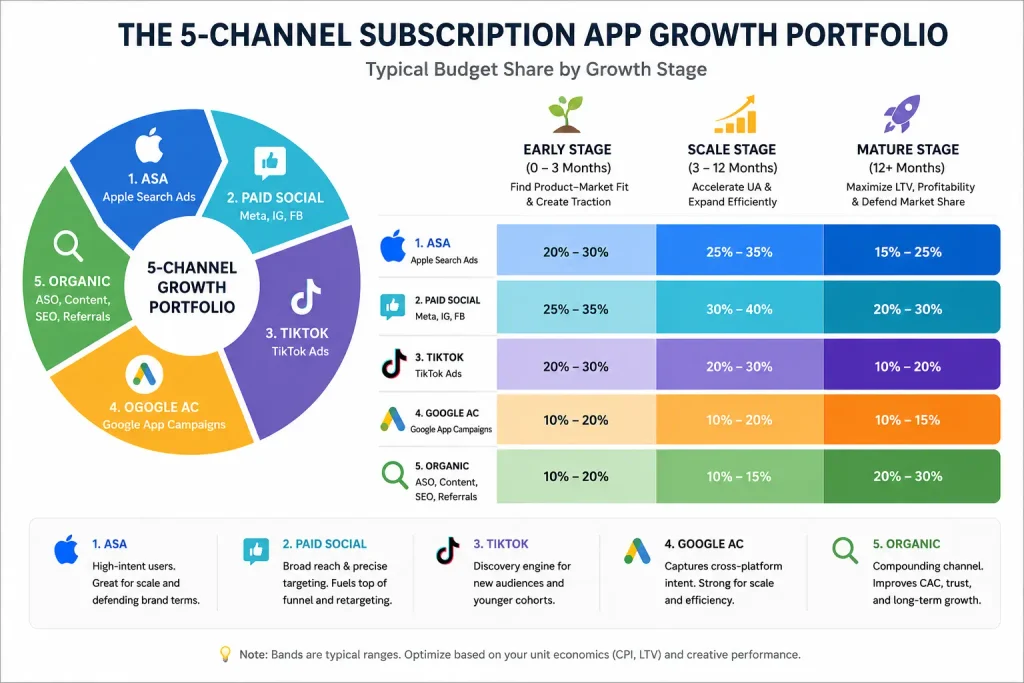
Channel selection works in a triple relationship with your growth stage, your current payback period, and your creative production capacity. The five channels below form the highest-return portfolio for subscription apps per 2026 benchmarks. The table maps each channel’s role before the detail.
| Channel | Role | Portfolio Share (typical) |
|---|---|---|
| Apple Search Ads | Highest-intent iOS acquisition | 25-40% (iOS-heavy apps) |
| Paid social | Scale backbone | 35-55% |
| TikTok (paid + organic) | Attention + conversion flywheel | 15-30% consumer, 10-15% B2B |
| Google App Campaigns | Reach + Android equivalent | 15-25%, up to 30-40% Android-heavy |
| Content-led organic | Durable moat, lowers paid CPI | 5-10% (separate budget) |
Apple Search Ads is 2026’s highest-intent paid channel for subscription apps. About 65 percent of App Store installs happen directly after a search (Apple), and a user who is searching for an app carries far higher purchase intent than users from any other channel. Per SplitMetrics’ 2026 Apple Ads Benchmarks, Search Results campaigns average a 66.2 percent conversion rate. The subscription advantage is payback: a fitness subscription app acquiring installs at a $5 CPI with 35 percent install-to-trial and 8-month retention can reach a D240 ROAS around 5.6x, a figure no other paid channel repeats under standard conditions. The full mechanics of this sit inside Apple Search Ads optimization.
The campaign structure for a subscription app runs in four layers: Brand Defense (protect your own brand terms, lowest cost-per-tap and highest conversion; skip it and you hand brand traffic to competitors), Category/Generic Keywords (the real scale engine, where most testing happens), Competitor Conquesting (bidding on rival brand terms, high cost but aggressive share strategy), and Discovery/Broad Match (variable, for keyword discovery rather than core scale). The weakness is reporting: Apple’s native dashboard stops at install level and cannot show which keyword produced which paywall conversion, so keyword-to-revenue attribution through a measurement partner is mandatory. The hard limit is that Apple Search Ads is iOS-only; for Android the nearest equivalent is Google App Campaigns, whose search component cannot match the same intent density.
Paid social (the largest platform plus its sister network) is the indispensable scale channel for the majority of subscription apps, for three reasons: mature attribution infrastructure (server-side conversion APIs, SKAdNetwork support), a wide audience database, and value-optimization bidding. Value-optimization bidding improves blended ROAS by 15 to 25 percent for subscription apps, but only when the revenue signals coming through the server-side conversion API are clean.
The optimal setup order: design the SKAdNetwork conversion-value schema around revenue-predictive events (trial start, paid conversion) rather than surface installs; integrate the server-side conversions API through your measurement partner, which recovers about 40 percent of post-ATT attribution loss; choose the deepest funnel event that fires at least 50 times per week per ad set as the optimization event (usually trial start or onboarding complete for early-scale apps, not purchase); move to value-optimization bidding once you clear 50-plus weekly trials or purchases; and lean on broad-audience-plus-strong-creative campaign types, whose share of paid budget has climbed to 40 to 60 percent for subscription apps in 2026. The weakness is CPM inflation: an app that cannot produce 40 to 60 new creative variants a month hits an inevitable plateau on paid social within 6 to 9 months. Paid social typically takes 35 to 55 percent of the blended paid portfolio, higher at early scale and healthier below 40 percent at maturity for channel-risk diversification.
TikTok occupies a distinct role for subscription apps in 2026: the only channel that fuses a paid and an organic layer. Its uniqueness is that organic feeds paid. An app posting 3 to 5 organic pieces a week sees its paid campaigns run at lower CPM and higher click-through. Three structures maximize the effect: boosting organically strong content with budget (ideal 2026 split for subscription apps is 50 to 60 percent boosted organic, 30 to 40 percent in-feed, 5 to 10 percent search), a micro-creator collaboration program (2 to 3 micro creators of 10K to 100K followers a week, producing 3 to 5 times the engagement of mega influencers at a fraction of the cost), and TikTok Search Ads (critical in an environment where 62 percent of 18-to-24-year-olds use TikTok as a search engine). The structural weakness is attribution: the gap between measurement-partner ROAS and platform-reported ROAS is wider than on paid social, so blended attribution is mandatory when evaluating TikTok. Its portfolio share is category-dependent: 20 to 30 percent for consumer apps (wellness, social, entertainment), 10 to 15 percent for B2B mobile. Apps that cannot produce 15-plus videos a month should keep TikTok budget low, because the platform penalizes low-output brands with rising CPM.
Take Advantage of Automation with Artificial Intelligence!
How can you use your time more efficiently? Artificial intelligence saves you time by automating repetitive tasks. Learn how you can leverage AI to accelerate your business processes.
Google App Campaigns is the Android-side equivalent of paid social for subscription apps, and Google Search campaigns’ App Store redirect capability matured in late 2025 for the iOS side. Its three advantages: an intent spectrum spanning search, video, Play, and display in one campaign; target-ROAS bidding that produces solid results for subscription apps once you feed it full revenue data; and web-to-app capability, where the search-plus-web-paywall-plus-deeplink funnel is one of 2026’s fastest-growing subscription tactics. The weakness is control, since the algorithm is opaque about where it spends, which slows troubleshooting. Teams that do not run thorough Google Ads campaign optimization use only about half of the channel’s real potential. Google’s portfolio share is typically 15 to 25 percent, rising to 30 to 40 percent for Android-dominant apps.
Your Visuals Stand Out But You're Not Getting Any Feedback?
Get a Free Design Audit Now!
Let's evaluate together how you can better engage with your target audience visually, dysfunctional designs, and tips to increase engagement. Fill out the form now and get your free analysis report!
Despite how large the paid channels look, the most sustainable channel for subscription apps is content-led organic growth, which systematically beats paid on ROAS. It has three sub-layers. First, ASO, where Google Play’s 2026 shift from install-volume to retention-focused scoring is a structural advantage for subscription apps (low churn means high ranking), and good ASO work lowers paid CPI by 15 to 30 percent within 90 days. Second, SEO and a content-led web funnel targeting category-specific problem searches, especially in “how to do X” format, which pairs with a web paywall to bypass the app-store commission at low CAC. Third, founder content, with the founder and marketing leads publishing regularly, which has become a lead channel for B2B subscription apps. The real value of organic is not its standalone ROAS but the halo effect: apps with high organic brand awareness produce 20 to 35 percent lower CPA on their paid campaigns, which lowers blended CAC for teams that run both together.
Peaker Note: Channel Timing Matters as Much as Channel Choice
On a B2C wellness subscription client, the first 60 days put 80 percent of budget into paid social and trial-to-paid stalled at 18 percent. Opening Apple Search Ads and ASO first, then scaling paid social, lifted the same budget to 24 percent…
The biggest error in subscription app growth is thinking about the marketing channel independently of the paywall. The same user from the same channel produces up to twice the LTV between a well-designed paywall and a weak one. Teams that optimize channel selection before optimizing the paywall waste roughly 40 percent of their paid budget. Three paywall insights from Adapty’s 2026 report: the onboarding-paywall-plus-trial combination produces the highest conversion of any setup (around 1.78 percent), so the user’s first 60 seconds are critical; a weekly-plan-plus-trial produces about 1.5 times the average LTV of other setups, and annual-trial paywalls stand out too ($66.70 versus $49.92 one-year LTV in the AI category); and test discipline matters, with apps running an average of about 15 experiments per test having the nerve to test not just visuals but plan structure, trial length, and pricing (price tests raise LTV about 46 percent of the time but win on conversion rate only about 28 percent of the time, so they need careful evaluation).
The retention math is similar. Per benchmark data, D30 retention runs about 4.2 percent for shopping and 11.2 percent for finance, and even a few points of D1 retention improvement multiplies cohort LTV. This is why the 2026 paid UA operation has to sit at the same table as the retention team; apps that silo UA and retention typically carry blended CAC 20 to 30 percent higher. The retention tactics that most affect paid performance are a 2-to-3-push sequence in the first 72 hours, a 48-24-6-hour pre-trial-end reminder rhythm, and a 7-14-30-day winback email for churned users. Without those three structures, no matter how good the reported ROAS looks, the real payback period blows out. This connects directly to the broader mobile app retention work that determines whether acquired users ever reach the payback window.
Judging your subscription channels on day-1 ROAS and not sure which are actually profitable?
Digipeak rebuilds subscription channel portfolios on cohort ROAS and retention-adjusted CPI, sequences which channel opens first, and orchestrates the five channels against your payback period. Get in touch for a subscription growth audit.
Get a Growth Audit →The most critical operational decision in subscription app growth is designing the channel mix to fit your growth stage. Three scenarios, shaped by the same benchmarks.
Pre-launch and early-scale (monthly paid budget under $15K). First priority is ASO infrastructure and paywall optimization. On the paid side, Apple Search Ads plus paid social is enough: 40 to 50 percent ASA, 40 to 50 percent paid social, 5 to 10 percent TikTok for testing. Depth matters far more than channel count at this stage. Targets: D7 ROAS 0.4x, trial-to-paid 18 percent-plus.
Scale-up (monthly $15K to $75K). Paid social 40 percent, ASA 25 to 30 percent, TikTok 15 to 20 percent, Google App Campaigns 10 to 15 percent, content-led organic (on a separate budget) 5 to 10 percent. Creative production capacity should reach 40 to 60 variants per month here. Targets: D30 ROAS 0.8x, D90 2x-plus.
Mature scale ($75K-plus). Paid social 35 to 40 percent, ASA 20 to 25 percent, TikTok 15 to 20 percent, Google App Campaigns 10 to 15 percent, programmatic and alternative networks 5 to 10 percent, web-to-app funnel 5 to 10 percent. Channel diversification here is permanent structural insurance against algorithm changes. Targets: D30 ROAS 1x, payback period under 5 months.
These splits are a starting point, not an absolute. The right ratio for your app is a triple function of your payback period, your churn curve, and your LTV-to-CAC target. If you cannot read those three variables from your measurement partner, the infrastructure problem comes before the channel-selection problem.
Three mistakes recur when subscription apps measure channel performance: looking at first-day ROAS, mistaking platform-reported ROAS for real ROAS, and not calculating retention-adjusted CPI.
Read cohort ROAS, not day-one ROAS. Track D1, D7, D30, D90, and where possible D180 ROAS separately for each channel. A subscription app’s real ROAS typically does not appear before D90.
Make the measurement partner the primary source. Platform dashboards inflate figures because each platform claims double attribution on the same user; per GA Connector’s 2025-2026 analysis, marketing platforms inflate real ROAS by an average of 2.3 times.
Calculate retention-adjusted CPI. Retention-adjusted CPI is CPI divided by D30 retention rate. A $4 CPI at 5.7 percent D30 retention is a $70 retained-user cost; the same $4 CPI at 28 percent retention is a $14 retained-user cost, a five-times difference. This is the only sound basis for comparing channels.
Three key numbers show the health of your subscription growth: the LTV-to-CAC ratio (3:1 is the minimum threshold, 4:1 the healthy B2C level; channels running below 2:1 do not produce long-term profit), the payback period (4 to 5 months ideal for B2C, 8 to 9 for B2B, with anything over 12 months signaling a structural problem), and blended CAC across paid and organic (looking at paid CAC alone blinds you to 40 percent of the channel-selection picture, because the halo effect only appears in the blended metric). Teams that can break these three numbers down by channel lower their CAC 25 to 40 percent within 12 months; teams that cannot never reach profitable subscription growth despite aggressive top-line numbers.
When you build or revise your channel portfolio, seven questions should drive the decision. Your answers set your channel hierarchy.
Subscription apps that answer “green” to four of these seven get the highest return from their channel choices in 2026. At three or below, infrastructure revision should come before channel optimization.
There is no single “best” channel; subscription app growth in 2026 is portfolio optimization. For iOS, Apple Search Ads gives the highest intent and ROAS (a D240 ROAS potential around 5.6x), while for Android, paid social plus Google App Campaigns lead. A healthy subscription portfolio is usually built around ASA 25 to 30 percent, paid social 35 to 40 percent, TikTok 15 to 20 percent, Google 10 to 15 percent, and organic 5 to 10 percent, with the ratios shifting by growth stage.
A healthy subscription app’s CAC should be at most one third of the app’s 12-month LTV (the 3:1 LTV-to-CAC threshold). Median healthy B2C LTV-to-CAC is around 4:1, and B2B and enterprise apps sit around 3.5 to 4:1. On payback, under 4 to 5 months is ideal for B2C and under 8 to 9 months for B2B. When these numbers do not hold, the fix is monetization (paywall, plan structure, trial length), not channel.
If you publish a subscription app on iOS, Apple Search Ads is the highest-intent channel in your paid portfolio. About 65 percent of App Store installs happen after a search, and the user is searching with direct purchase intent. Per SplitMetrics 2026, the average conversion rate is 66.2 percent. The Brand Defense campaign in particular should be set up first, because it stops competitors from advertising on your brand terms. For Android-only apps, ASA is not available and Google App Campaigns is the nearest alternative.
Success rests on four steps: design the SKAdNetwork conversion-value schema to be revenue-predictive, integrate the server-side conversions API through your measurement partner, choose the deepest funnel event firing 50-plus times weekly as the optimization event (usually trial start), and move to value-optimization bidding after 50-plus weekly trials. This setup improves blended ROAS 15 to 25 percent for subscription apps. The biggest lever on CPA is creative production volume: 40 to 60 variants a month is the minimum threshold for subscription scale.
They complement each other; the right question is not “which first” but “how do they feed each other.” ASO and content-led organic lower paid CPI by 15 to 30 percent, and apps with high organic brand awareness produce 20 to 35 percent lower CPA on paid campaigns. The practical sequence: in the first 60 days, before scaling paid, build ASO, paywall, and attribution infrastructure. Then open paid channels gradually, running organic content production in parallel with the paid campaigns.
Web paywalls became an alternative to in-app purchase in the US market from mid-2025 and are a new layer of subscription strategy in 2026. In-app paywall conversion runs about 1.60 percent and web about 1.10 percent, but web bypasses the app stores’ 30 percent commission. Web leads on M1 retention (64.5 percent versus 46.2 percent) but in-app leads by M6. The strategic value is not only monetization but channel diversification: the search-plus-web-paywall-plus-deeplink-to-app funnel is one of 2026’s fastest-growing subscription tactics.
TikTok is a strong but category-dependent channel for subscription apps in 2026. Wellness, social, entertainment, and education are the verticals that benefit most from the platform’s high engagement. For B2B mobile subscriptions, TikTok share should not exceed 10 to 15 percent, because the decision-maker audience is not yet concentrated there. TikTok’s real strength for subscriptions is the organic-plus-paid flywheel: organic content improves paid click-through by up to 40 percent over 60 to 90 days. For brands that cannot produce 15-plus videos a month, TikTok does not support aggressive budget.
The conversation about the most effective marketing channels for subscription app growth is evolving in 2026 from channel comparison to portfolio orchestration. Apple Search Ads brings the high-intent user, paid social brings scale, TikTok brings the attention-and-conversion flywheel, Google brings reach and Android access, and organic brings the durable moat. Built together, these five lower CAC while strengthening the LTV-to-CAC ratio; brands that skip one or grow one channel’s budget out of balance produce a structural problem within 6 to 12 months.
Three concrete steps for tomorrow: first, recalculate your current channel performance on retention-adjusted CPI and D90 cohort ROAS, because if you are working from raw CPI, that single step will surface at least one false-positive channel in the first week; second, if your trial-to-paid rate is below 20 percent, prioritize paywall and onboarding optimization over paid scale, because every paid dollar spent before that infrastructure is fixed runs structurally inefficient; third, if your organic portfolio (ASO plus content-led SEO plus founder content) sits in a separate silo from paid, merge them into one team, because the halo effect is one of the least-managed levers in subscription app growth.
A forward look: between 2026 and 2027, two structural shifts are coming to the subscription economy. Android privacy changes will shift the attribution math again, and AI-generated content becoming standard in subscription app advertising will equalize the creative-production advantage and make distinctive creative strategy the new moat. The way to prepare for both is to build your channel portfolio on a correct attribution foundation today and to systematize your capacity to generate creative hypotheses.
At Digipeak, subscription app growth is orchestrated as five channels under one performance framework. Every engagement opens with a 30-day attribution and paywall audit: measurement-partner configuration, SKAdNetwork compliance, server-side conversions API integration, and paywall conversion metrics are all clarified in this phase. The second 30 days build the channel portfolio and take the first pilot campaigns live; from the third month, scale decisions are made on cohort-based measurement. This connects to the wider app store optimization foundation that lowers paid CPI before the channels even scale.
The team operates from London, Istanbul, and Texas, managing an internationally-expanding subscription app with localization precision, which matters because cross-market CPI can differ 5 times and LTV 3 to 4 times. Google and Meta Partner status lets the team track platform updates at the beta stage and adapt clients 30 to 60 days ahead of the market. Depth in SaaS and B2B mobile adds a distinct advantage in the subscription vertical, because B2B subscription payback, decision-maker segmentation, and channel economics differ structurally from consumer apps.
With more than 100 satisfied clients and over $5 million in managed ad spend, Digipeak builds a channel mix that fits each subscription app’s LTV-to-CAC math, growth stage, and geographic targets. If your channel decisions are being made on day-one ROAS, the payback-period recalculation is where the conversation should start.

Join the
Digipeak Newsletter!
Stay up to date with the latest digital marketing insights, trends, and updates. Subscribe today!
Related Articles
There is a brutal piece of math behind every paid user acquisition budget. Teams that …
The most expensive mistake in mobile app funnel optimization is fixing the wrong stage. A …
The most expensive mistake in ASO localization is not a bad translation. It is localizing …
If you run iOS user acquisition, you have almost certainly been frustrated by SKAdNetwork. Conversions …


