

AI Mobile App Growth 2026: The Tools Playbook by Growth Function
AI mobile app growth shifted from experimental side project to operational infrastructure between 2024 and …


 ★★★★★ 5.0 · 100+ reviews








Table of Contents
MEET OUR TEAM!
Ask Play is no longer a rumor buried in APK teardown reports. As of mid-2025, Google’s Gemini-powered feature is actively appearing on app listing pages inside the Play Store and it is changing the way more than 4 billion Android users evaluate, question, and ultimately decide to install apps. For anyone working in app marketing or App Store Optimization (ASO), what follows is important, not as a distant trend to monitor, but as a live shift that is already affecting conversion rates.
Most app marketers are still treating Ask Play as a curiosity. That is a mistake. When an AI model starts reading your app’s metadata and answering user questions in real time, directly beneath the Install button, the rules of how you write a description, structure your listing, and manage your reviews change significantly. Pay attention to this section: because the teams that understand this early will hold a meaningful advantage.
Ask Play is a Gemini AI-powered feature embedded directly inside Google Play Store app listing pages. Appearing as a text input box labeled “Ask Play about this app,” the feature lets users type natural language questions about an app, or tap pre-generated suggested queries, and receive instant AI-generated answers without leaving the Play Store. Google first identified this feature in code analysis in October 2024, included it in the November 2024 Play System Update changelog, and began a wider public rollout with Play Store version 46.1.39-31 in May 2025.
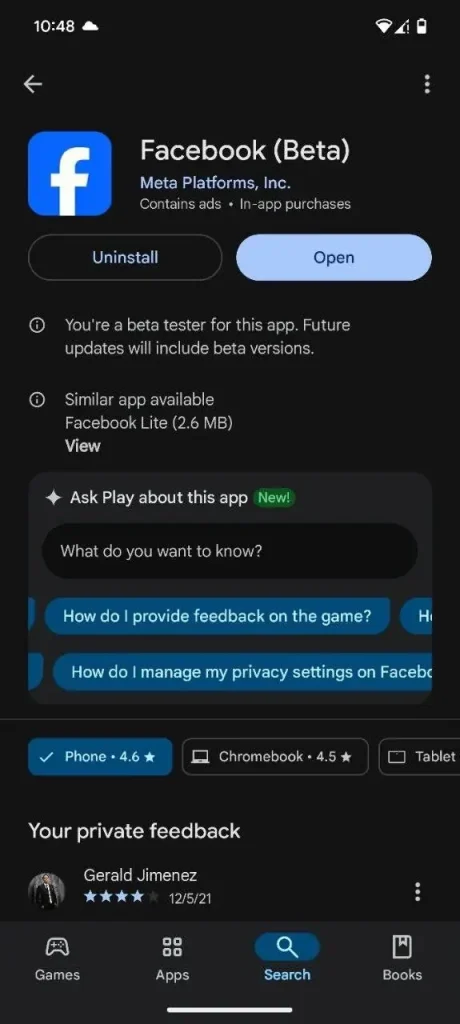
Quick Answer: Ask Play is Google’s AI-driven Q&A tool built into the Play Store, powered by Gemini. It reads app metadata, user reviews, and contextual data to answer questions from prospective users in real time, directly on the app listing page, reducing the need to search for answers externally before installing.
The Gemini star icon marks every response with a “Created by AI” label, signaling to users that the answer is machine-generated rather than pulled from developer documentation. This transparency matters because it sets accurate user expectations — and it matters to you as a marketer because Gemini is reading your listing to construct those answers.
Understanding the mechanics behind Ask Play is the first step to working with it rather than around it. The feature operates through a conversational interface that sits on individual app listing pages. Here is the step-by-step flow a user experiences:
It is important to note what Gemini does not do here: it does not compare your app to competitors, and it does not generate opinionated endorsements. The model is constrained to factual responses about the specific app being viewed. When asked whether an app is “optimized for tablets” or “better than” a competing tool, Gemini declines or fails to respond — a design choice that keeps the feature neutral but also limits its depth for highly specific or technical queries.
Google moved faster than usual with Ask Play, even by its own standards for consumer-facing AI features. The path from code to public rollout was compressed into roughly seven months:
That last development — Ask Play responding directly from the search bar — signals a fundamental change in how the Play Store discovery funnel works. The store is shifting from a directory model to an intent-resolution model. Instead of surfacing a list of apps for a query, it is beginning to answer the query directly.
In live testing across dozens of popular app listings, the feature demonstrates genuine utility for pre-installation decision-making. The questions it handles well tend to be functional and factual:
Where Ask Play struggles is with comparative, subjective, or highly specific queries. Questions like ‘Is this better than [alternative]?’ or ‘Is this app optimized for tablets?’ either return incomplete answers or nothing at all. The feature also relies heavily on what is actually in the app’s listing. If the description is thin, the reviews are sparse, or the ‘What’s New’ section hasn’t been updated in months, Gemini has limited material to work with — and the quality of its answers degrades accordingly.
According to ASO monitoring data from AppTweak and ASOWorld, the December 2025 Play System update confirmed that Ask Play generates answers using a combination of app metadata, user reviews, and inferred contextual signals. That combination is the key unlock for app marketers: it means that every element of your listing that a user might once have scrolled past is now being actively indexed and synthesized by an AI model to answer prospective users’ questions.
| 🔴 Peaker Note: The Thin Listing Problem In campaigns we’ve run for SaaS and utility app clients, one of the most consistent patterns we see is that app descriptions are written for keyword density, not for clarity. Ask Play exposes this immediately, when Gemini can’t find a clear answer to ‘How does onboarding work?’ or ‘What happens after the free trial?’, neither can a prospective user. Thinly written listings don’t just underperform in traditional ASO; they underperform with AI-mediated discovery. |
The ASO discipline has spent years optimizing for keyword ranking in a list-based search interface. Ask Play introduces a different kind of surface: one where your listing’s content is read, synthesized, and delivered conversationally. That requires a different kind of optimization thinking.
Your app title, short description, long description, and ‘What’s New’ section have always mattered for keyword indexing. Now they also function as the source material from which Gemini constructs answers. According to data from ASO research platforms, Ask Play generates responses by indexing app metadata combined with review signals and contextual data from the listing. This means:
The practical implication: treat your long description the way a content strategist treats an FAQ page — with structured answers to the questions your target users are most likely to ask. According to ASOWorld’s December 2025 system update analysis, apps may see 15–30% lower organic installs even if keyword positions appear unchanged, because the shift is from rank-based discovery to relevance and metadata accuracy.
Ask Play surfaces information from user reviews as part of its answer construction. This creates a new dimension to review management. A cluster of reviews mentioning a specific bug, a confusing onboarding flow, or a missing feature doesn’t just lower your star rating — it can now directly influence what Gemini tells prospective users about your app.
The counter-strategy here is proactive: respond to negative reviews promptly and accurately, encourage reviews from satisfied users at the right moment (post-completion of a key in-app action, not post-install), and monitor what thematic clusters are appearing in your review topics. Whatever users are saying most consistently is likely what Ask Play is drawing on.
There is an interesting tension baked into Ask Play. On one hand, users who get good answers to their questions before installing are more likely to be genuinely qualified — reducing churn from misaligned expectations. On the other hand, as the ASO Project has noted, users who get their questions answered directly in the Play Store may spend less time on your listing itself, compressing the window in which your screenshots and creative assets can work. That puts a premium on visual clarity: your first two or three screenshots need to communicate core value instantly, because Ask Play may be compressing the amount of reading users do.
Ask Play is not a standalone feature. It is one piece of a significantly larger AI integration strategy that Google announced and began deploying across the Play Store from September 2025 onward. Understanding the full picture matters because it tells you where the platform is heading — and where app marketing attention needs to go.
The underlying theme across all of these changes is that Google is converting the Play Store from a transactional download point into a persistent engagement platform. Ask Play is the discovery layer of that transformation. The Sidekick is the retention layer. Personalized collections are the re-engagement layer. App marketers who treat the Play Store as a place to land a download and move on are optimizing for a model that Google is actively dismantling.
| 🔴 Peaker Note: The Search-to-Store Collapse What Ask Play’s evolution into the search bar represents is the collapse of the search-to-store funnel into a single surface. Historically, a user would Google a question, land on a review site or comparison article, and then navigate to the Play Store. Ask Play is Google’s bet that it can own that entire journey. Answering the question and surfacing the install within the same interface. For app marketers running both SEO and ASO strategies, this compression should raise a question: are your web and store presences aligned, or are they telling different stories to the same user? |
The practical response to Ask Play doesn’t require rebuilding your entire ASO strategy from scratch. It does require a targeted set of adjustments that align your listing with how AI-mediated discovery works. Here is a structured approach:
The longer-term trajectory of Ask Play, based on where Google has already taken the feature by early 2026, points toward an increasingly conversational Play Store interface. When Ask Play began appearing directly in search results — answering user queries without requiring a specific app listing to be open — it crossed a threshold that matters strategically.
At that point, a user can type ‘I need a budget tracking app that works offline’ into the Play Store search bar and receive a conversational response that recommends and explains options, rather than displaying a ranked list. For app marketers, the implications ripple outward:
For SaaS and B2B app products in particular, this evolution is worth watching closely. These categories have historically relied on web-first content strategies to drive app awareness, with the Play Store functioning more as a download destination than a discovery surface. Ask Play shifts the calculus: the store itself is becoming capable of answering the “why should I download this?” question that previously required a landing page, a blog post, or a review site to answer.
Ask Play represents something more significant than a new feature checkbox on the Play Store’s product roadmap. It signals a structural shift in how app discovery, evaluation, and installation decisions are made by users at scale.
Three findings stand out as the most actionable takeaways from everything covered above. First, your app listing’s content quality now has a direct line to user conversion through AI mediation — thin, keyword-heavy descriptions are being read aloud by Gemini to prospective users, and the results are audible. Second, review management has become a real-time input to what AI surfaces about your product, making reputation management a core ASO function rather than a secondary one. Third, Google is not stopping at app-listing Q&A: the evolution of Ask Play into the search bar tells you that the Play Store’s entire discovery model is converging toward intent resolution rather than keyword ranking.
The teams that act on this now — auditing their metadata, restructuring their descriptions, and aligning their review strategy — are building a position that will compound as Google extends Ask Play’s reach. Those still optimizing for a list-based ranking model are optimizing for a surface that is being actively redesigned.
Take Advantage of Automation with Artificial Intelligence!
How can you use your time more efficiently? Artificial intelligence saves you time by automating repetitive tasks. Learn how you can leverage AI to accelerate your business processes.
At Digipeak, ASO is not a checklist exercise — it is a continuous strategy aligned with where the platform is actually going. As a Google Partner agency working with SaaS and B2B clients across London, Istanbul, and Texas, we have watched the Play Store’s AI integration evolve closely, and we have been adapting client listing strategies accordingly well before Ask Play’s public rollout.
Our ASO approach starts with a data-first audit of your existing listing — not just keyword gaps, but structural content gaps. What questions are your prospective users most likely to ask? Are those questions answered clearly within your metadata? What does your review corpus signal about user perception versus your intended positioning? Those are the questions that now determine how Ask Play performs for your product.
We work with app marketing teams to build listing content that reads for both traditional keyword indexing and AI comprehension — a distinction that requires editorial thinking, not just optimization tooling. Our broader digital strategy practice, including content marketing and our data-driven approach to search optimization, means our app clients benefit from strategies that align their web presence and store presence rather than treating them as separate channels.
With $5M+ in managed digital ad spend and 100+ clients across sectors, Digipeak brings the kind of cross-channel pattern recognition that individual app teams rarely have access to internally. If you are ready to see where your app listing stands in an AI-mediated discovery environment, we are ready to look at it with you.
Your Visuals Stand Out But You're Not Getting Any Feedback?
Get a Free Design Audit Now!
Let's evaluate together how you can better engage with your target audience visually, dysfunctional designs, and tips to increase engagement. Fill out the form now and get your free analysis report!
Ask Play is a Gemini AI-powered feature integrated into Google Play Store app listing pages. It displays a text input box labeled ‘Ask Play about this app,’ allowing users to ask natural language questions about an app and receive instant AI-generated answers. The feature uses the app’s metadata, user reviews, and contextual signals to generate its responses, and is labeled ‘Created by AI’ to indicate the source. It began rolling out publicly in May 2025 with Play Store version 46.1.39-31.
Ask Play can influence conversion rates in two ways. Users who receive clear, accurate answers to their questions before installing are more qualified — reducing churn from misaligned expectations. However, if your listing content is thin or your reviews carry negative thematic signals, Ask Play may surface incomplete or unflattering information. Apps with rich, well-structured descriptions and actively managed reviews are better positioned to benefit from the feature.
Yes. According to ASO monitoring data and Google Play System update notes, Ask Play generates answers by combining app metadata (title, description, ‘What’s New’ section), user reviews, and inferred contextual signals. This makes your long description and review corpus the primary source material for AI-generated responses. Descriptions written with natural, informative language that anticipates user questions will produce more accurate and useful Ask Play answers than keyword-optimized but unclear copy.
As of early 2026, Ask Play is available across a broad range of app listings for users running Play Store version 46.1.39-31 or later with recent Google Play System updates. The feature initially appeared only on popular apps including WhatsApp, Instagram, Spotify, Uber, and YouTube Music. Coverage has expanded significantly since then, though the rollout remains gradual and territory-dependent. The expanded chat interface — responding from the search bar — was spotted in version 50.0.23-31 in February 2026.
The most effective approach is to structure your long description to answer the questions your target users are most likely to ask, in clear natural language rather than keyword strings. Test Ask Play against your own listing with common support questions to identify gaps. Update your ‘What’s New’ section with each release, respond to reviews within 24–48 hours, and monitor thematic review clusters monthly. Treat your description as a conversation resource, not a keyword container.
Ask Play is a Google Play Store feature specific to Android and is not available on iOS or the Apple App Store. Apple has introduced its own AI-driven features, including AI-generated App Store Tags announced at WWDC 2025, which categorize apps based on metadata and screenshots for browse placement. Both platforms are moving toward AI-mediated discovery, but through different mechanisms requiring distinct optimization strategies.
Not immediately — but it is changing what effective keyword optimization looks like. Traditional ASO keyword ranking remains important for initial discovery in list-based search results. However, Ask Play adds a layer where content quality, structural clarity, and review quality determine how your app performs in AI-mediated evaluations. The shift is from optimizing purely for ranking position to optimizing for ranking position and AI comprehension simultaneously. Keyword optimization is evolving, not disappearing.

Join the
Digipeak Newsletter!
Stay up to date with the latest digital marketing insights, trends, and updates. Subscribe today!
Related Articles
AI mobile app growth shifted from experimental side project to operational infrastructure between 2024 and …

App Store vs Google Play ASO differences are not a stylistic preference. They are a …

April 2021 was a watershed moment for mobile measurement. Apple’s App Tracking Transparency framework ended …

The decision to bring in an external ASO agency usually arrives after a specific moment …


