

AI Mobile App Growth 2026: The Tools Playbook by Growth Function
AI mobile app growth shifted from experimental side project to operational infrastructure between 2024 and …


 ★★★★★ 5.0 · 100+ reviews








Table of Contents
MEET OUR TEAM!
Mobile app advertising now commands more than half of all global digital ad spend — and yet a disproportionate share of app marketing budgets consistently underperforms. According to eMarketer, global mobile ad spending surpassed $362 billion in 2023 and continues its upward trajectory, but the campaigns that fail aren’t failing for lack of budget. They’re failing because of format mismatch.
Most app marketers choose the format they know best, not the one best suited to their goal. A gaming company runs interstitials because ‘that’s what gaming companies do.’ A fintech startup pours its entire launch budget into Google App Campaigns without testing Meta. The result? Mediocre cost-per-install figures, flat retention curves, and product teams who start questioning whether paid acquisition works at all.
It does work. It just requires matching the right mobile app advertising format to the right objective at the right growth stage. That’s exactly what this guide maps out — every major format, what it costs, and when to use it.
Mobile app advertising refers to paid promotional activity designed to drive app installs, in-app actions, or re-engagement across mobile environments. Unlike traditional display advertising, mobile app advertising operates within a performance framework where the primary conversion unit is the install, registration, purchase, or subscription. measurable at the individual user level through mobile attribution platforms.
The category spans multiple channels and format types: paid search (Google App Campaigns, Apple Search Ads), paid social (Meta, TikTok, Snapchat), in-app display networks, programmatic demand-side platforms (DSPs), and rewarded inventory within mobile games and utility apps. Each format reaches users at a different stage of intent, and each carries distinct cost structures and targeting capabilities.
Here’s a consistent pattern observed across mobile growth programs: campaigns that fail rarely do so because of poor creative or insufficient budget. The root cause is almost always format misalignment. Allocating 80% of a launch budget to top-of-funnel awareness video when the goal is immediate installs is one of the most common structural errors in the industry.
The numbers support this. According to AppsFlyer’s 2023 State of App Marketing report, the global average cost-per-install sits around $3.40 for Android and $5.28 for iOS — but campaigns that mix formats and channels see up to 34% lower CPI compared to single-channel approaches. Different formats reach users at fundamentally different intent levels, and intent is the variable that drives conversion rates.
Understanding the format landscape isn’t optional for any team serious about mobile marketing ROI. Below, we map every significant format — its mechanics, cost range, and the conditions under which it performs.
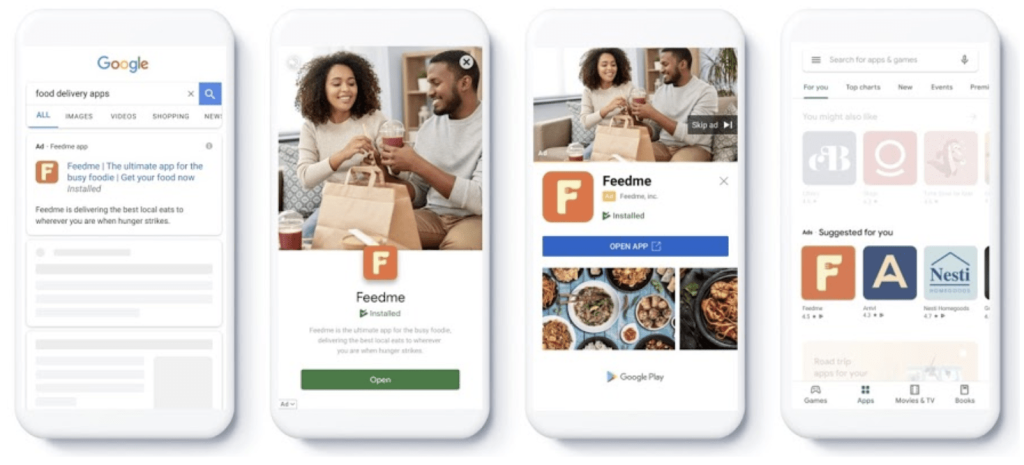
Google App Campaigns — previously called Universal App Campaigns — are the most widely deployed paid channel for app installs globally. The format feeds creative assets (headlines, descriptions, images, videos) into Google’s machine learning system, which then distributes them across Google Search, Google Play Store, YouTube, Gmail, and the Google Display Network. The system automatically allocates budget across these placements based on conversion signals.
The search intent component is what sets UAC apart. When someone searches ‘best budget tracking app,’ a relevant ad appears with a direct install prompt in the Play Store or search results. That intent signal — a user actively looking for an app like yours — is a premium resource in mobile advertising.
Best for: Acquisition at scale, particularly for apps in high-search-volume categories — finance, productivity, health, gaming.
Avg. CPI benchmark: $0.80–$3.50 for Android; $2.00–$7.00 for iOS (varies by vertical and market; source: Adjust Mobile Finance Report 2023).
Practical signal: Feed Google at least 20 high-quality creative assets across formats. The algorithm rewards creative volume with faster optimization cycles and better CPI outcomes.
For teams running Google App Campaigns at scale, a structured Google Ads campaign management approach makes a measurable difference in cost efficiency — particularly at the bid strategy and conversion event setup levels.
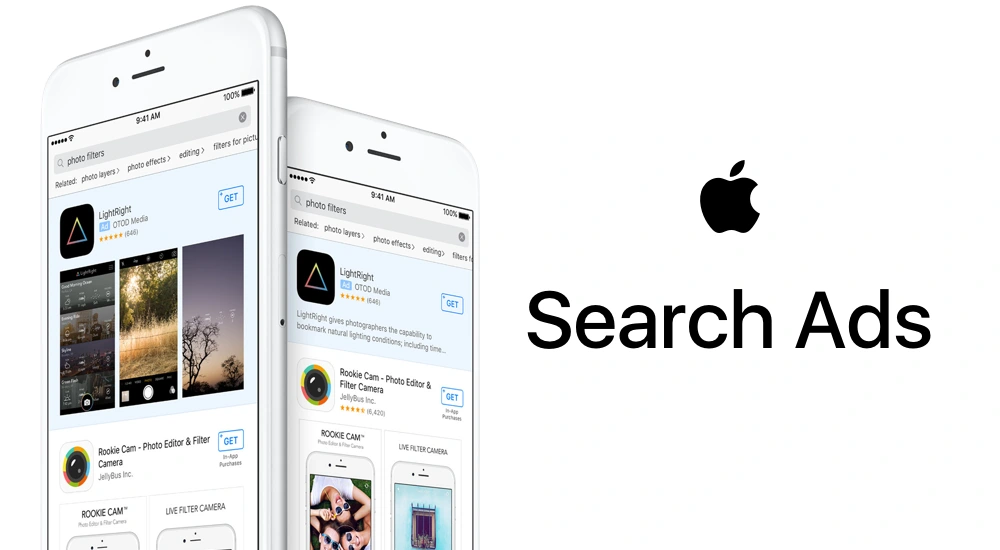
Apple Search Ads place your app directly at the top of App Store search results when users search for relevant terms on iOS. Since the App Store is the conversion environment, user intent is extraordinarily high — someone searching ‘meditation app’ is already one tap away from installing.
There are two campaign types: Search Results campaigns (keyword-targeted, shown at the top of search) and Today Tab / Browse placements (discovery-focused, shown on the App Store home tab). For most growth-stage apps, Search Results campaigns deliver the most predictable ROAS.
Average conversion rates for Apple Search Ads consistently outperform other channels for iOS apps. According to Apple’s own benchmarks, Search Results campaigns deliver a 65% or higher tap-to-install rate in many verticals — versus 20–30% for social app install ads.
Best for: iOS-focused apps where keyword intent is strong — utilities, productivity, lifestyle, health.
Critical consideration: ASO performance directly affects ASA cost efficiency. A well-optimized App Store listing reduces tap-through costs significantly. This is why App Store Optimization and paid search on the App Store should be managed in coordination, not in isolated silos.
| 📌 Peaker Note In mobile app campaigns, Apple Search Ads perform best when keyword targeting is layered with competitor and category targeting — bidding on adjacent terms used by apps in your category. Most brands focus only on exact-match branded terms and leave high-intent discovery traffic on the table. Testing Search Match (Apple’s automatic keyword expansion mode) for 2–3 weeks before switching to manual keyword selection almost always surfaces 15–25% more relevant query coverage that would otherwise be missed. |
Meta’s app advertising ecosystem remains the dominant social channel for mobile app installs globally. The reason is audience depth: with over 3.2 billion monthly active users across Facebook and Instagram (Meta Q4 2023 Earnings), the targeting precision — by interest, behavior, demographic, lookalike, and custom audience — is unmatched in social advertising.
Meta App Install ads support multiple formats: single image, carousel, video, and Advantage+ App Campaigns (Meta’s AI-driven automation that mirrors Google’s UAC model). The Advantage+ App Campaign format has demonstrated significant CPI reductions of 7–25% compared to standard app campaigns in Meta’s own benchmark data.
Best for: B2C apps with broad audience potential — e-commerce, entertainment, gaming, lifestyle. Also performs well for B2B SaaS apps with specific professional persona targeting via detailed interest stacks.
Creative principle: Video consistently outperforms static for app install ads on Meta. According to Meta’s internal data (2023), video creatives drive 20–35% lower CPI than static for mobile app objectives. Keep the first-frame hook under 3 seconds — thumb-stopping relevance matters more than production value at this stage.
For a structured approach to social app advertising across Meta’s full product suite, social media advertising management integrates creative strategy with audience architecture for measurable install volume.
Take Advantage of Automation with Artificial Intelligence!
How can you use your time more efficiently? Artificial intelligence saves you time by automating repetitive tasks. Learn how you can leverage AI to accelerate your business processes.
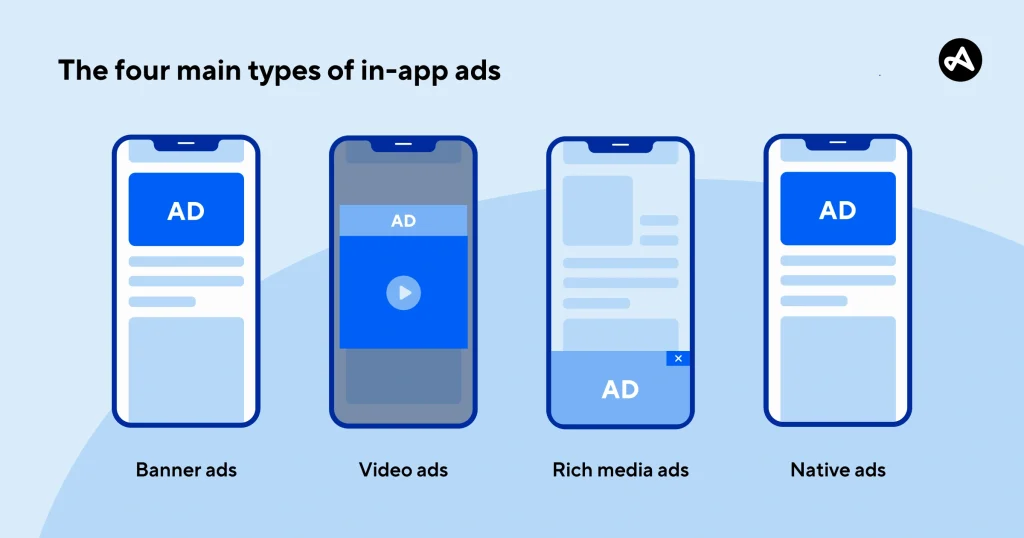
In-app display ads appear within other mobile apps — typically as banner ads at the top or bottom of the screen, medium rectangle formats embedded within content, or native ads that blend with editorial feeds. These are served through ad networks and DSPs that aggregate inventory across thousands of publisher apps.
Banner ads carry the lowest CPM in mobile advertising — averaging $1–$3 globally (Statista, 2023) — which makes them attractive for awareness campaigns on paper. However, click-through rates average just 0.06% industry-wide, and banner blindness is well-documented: users have trained themselves to ignore fixed banner zones.
When they work: Retargeting warm audiences who have already visited your app page or engaged with your brand. Banner impressions at low CPM reinforce brand recall without requiring high click volume.
When they don’t: Cold user acquisition. Running banner ads to a completely new audience in a competitive category almost never produces viable CPI numbers — the math rarely works at 0.06% CTR.
Your Visuals Stand Out But You're Not Getting Any Feedback?
Get a Free Design Audit Now!
Let's evaluate together how you can better engage with your target audience visually, dysfunctional designs, and tips to increase engagement. Fill out the form now and get your free analysis report!
Rewarded video is the highest-performing in-app ad format by engagement rate. The mechanic is opt-in: a user within another app — typically a mobile game — voluntarily watches a 15–30 second video in exchange for a reward (in-game currency, extra lives, premium content). Because viewing is voluntary, completion rates exceed 90% (IronSource/Unity Ads, 2023).
The downstream quality effect is significant. Users acquired through rewarded video have 3x higher 7-day retention rates compared to users acquired through click-based formats (AppsFlyer, 2023). The logic is simple: the user has already seen your full value proposition and made an informed choice to install.
Best for: Gaming apps, entertainment apps, apps with a clear value exchange. Works particularly well when the creative communicates the app’s core benefit within the reward context.
Primary inventory networks: Unity Ads, IronSource, AppLovin MAX, Liftoff.
| 📌 Expert Note Rewarded video has a counterintuitive limitation: it over-indexes on gaming audiences. If you’re advertising a fintech or healthcare app through rewarded video inventory, audience quality drops because the user base is dominated by mobile gamers. Segment rewarded video campaigns by app category targeting. Most DSP platforms allow publisher-level exclusions. Also filter for non-gaming publishers. It reduces inventory volume but dramatically improves post-install quality metrics and cost-per-engaged-user. |
Interstitial ads are full-screen ads that appear at transition points within an app — between game levels, when opening a content feed, or during natural pause moments. They’re intrusive by design, which is simultaneously their strength and their limitation.
CTR for interstitials is high — 2–5% on average — because the ad occupies the full screen and requires an active decision. But UX data tells a more complicated story. According to Google’s UX research, interstitials that interrupt active user tasks have a 70% negative impact on session experience when poorly placed. Apple has become increasingly strict about interstitial ad behavior during App Store review, and excessive interstitials demonstrably harm ratings.
Best for: Gaming apps with natural transition points. Poorly suited to utility or productivity apps where any interruption damages core UX and risks negative reviews.
Programmatic advertising refers to the automated buying of ad inventory through a demand-side platform (DSP), which accesses publisher networks, ad exchanges, and private marketplace deals in real time. For mobile app advertising, programmatic DSP campaigns offer the widest reach and the most granular audience targeting — layering device type, OS version, app category behavior, location, daypart, and third-party data signals.
Programmatic CPMs are generally lower than social channels, but the learning curve is steeper. Campaign performance depends heavily on audience data quality, creative variety, and frequency capping. For larger app publishers and enterprise-scale campaigns, programmatic DSP is often the most cost-efficient channel at volume.
A solid foundation in programmatic advertising mechanics is useful context before committing significant budget to DSP channels — campaign architecture and data input quality determine most of the outcome.
The table below consolidates benchmark data across all seven formats. Use it as a starting reference — actual costs vary significantly by vertical, region, creative quality, and campaign structure.
| Format | Avg. CPM | Avg. CPI | Best Use Case | Targeting Depth |
| Google App Campaigns | $3–$8 | $1–$7 | High-intent, scale | High (intent+interest) |
| Apple Search Ads | $2–$10 (CPT) | $1–$5 | iOS high-intent | High (keyword) |
| Meta App Install Ads | $5–$15 | $1–$8 | B2C broad audience | Very High |
| In-App Banner | $1–$3 | $10–$40 | Retargeting | Medium |
| Rewarded Video | $8–$15 | $2–$6 | Gaming/retention | Medium |
| Interstitial Ads | $5–$12 | $2–$8 | Gaming | Medium |
| Programmatic DSP | $1–$6 | $3–$15 | Scale, niche audiences | Very High |
Benchmarks sourced from: AppsFlyer State of App Marketing 2023, Adjust Mobile Finance Report 2023, Statista Mobile Advertising Data 2023.
Choosing an ad format isn’t about convention or familiarity — it’s about where you are in your growth cycle and what your campaign metric actually is. Below is a three-stage framework.
At launch, the primary objective is generating enough install volume for attribution platforms to build meaningful user profiles and for ad algorithms (Google, Meta) to exit their learning phases. The standard algorithm learning threshold is 50 conversions per campaign per week for both Google App Campaigns and Meta Advantage+.
Recommended format mix: Google App Campaigns (40% of budget) + Meta Advantage+ App Install (40%) + Apple Search Ads Search Results (20%, iOS-focused). This three-channel combination provides search intent coverage, social discovery, and App Store conversion simultaneously.
Once you have 2–4 weeks of data with a stable CPI at or below target, shift to a scaling model. The core principle: scale what works, not everything equally. If Google UAC delivers CPI 30% below target while Meta is at benchmark, increase Google budget first and run a creative refresh on Meta before scaling its spend.
Stage 2 is also when introducing rewarded video and in-app programmatic makes sense — primarily to access additional inventory and counteract frequency fatigue in your primary channels.
Post-install performance is where many growth teams leave the most money on the table. Re-engagement campaigns targeting users who installed but haven’t completed a key action — registration, first purchase, subscription — consistently deliver 5–8x lower cost-per-action compared to new user acquisition.
On Meta and Google, this means custom audience uploads (lapsed users, partial-funnel users) with creatives designed around the specific incomplete action. On programmatic DSP, it means retargeting via your mobile measurement partner’s deep-link audience segments.
Impressions and clicks tell you almost nothing about mobile app advertising performance. The metrics that indicate genuine campaign health are:
There is no format that ‘wins’ across all app categories and growth stages. The highest-performing mobile app advertising programs are built on a multi-format architecture where each channel serves a specific role, with budgets allocated based on performance data rather than assumptions.
A practical starting framework:
Mobile app advertising is paid promotion specifically designed to acquire new users for a mobile application, re-engage existing users, or drive in-app actions such as purchases and subscriptions. It operates across channels including paid search, paid social, in-app display networks, and programmatic platforms, with performance measured through install-level attribution. Formats include search ads, social app install campaigns, video ads, banner ads, and rewarded video units.
The cost of mobile app advertising varies widely by format, vertical, and geography. Average cost-per-install globally ranges from $0.80 (Android, gaming) to $7.00+ (iOS, finance). Google App Campaigns and Apple Search Ads typically deliver CPIs in the $1–$7 range for most categories, while Meta app install campaigns range from $1–$8 depending on audience competition. Total monthly budgets for meaningful data accumulation typically start at $3,000–$5,000 per channel.
The best ad format depends on your app category and growth stage. For iOS apps with strong keyword demand, Apple Search Ads delivers the highest intent-to-install conversion rates. For broad B2C audiences, Meta App Install campaigns with video creatives consistently produce strong CPI results. Google App Campaigns are the most versatile across Android and iOS for apps with broad category appeal. A multi-format approach outperforms any single channel in virtually all cases.
In-app advertising refers to ads served within another mobile application’s environment — as opposed to ads in a mobile browser. Formats include banner ads, interstitials, rewarded video, and native ads. In-app ads are purchased through mobile ad networks and DSP platforms and appear within publisher apps that have integrated an ad SDK. Advertisers can target based on the category and behavior of the publisher app’s user base.
Success in mobile app advertising is measured through acquisition metrics (CPI, IPM, click-through rate) combined with quality metrics (D1/D7/D30 retention, in-app event completion rates, LTV, and ROAS). Attribution platforms connect ad spend at the campaign and creative level to post-install user behavior, allowing optimization for downstream revenue rather than raw install volume.
A mobile app advertising agency specializes in planning, executing, and optimizing paid campaigns to grow mobile applications. Services typically include channel strategy, creative production, audience architecture, attribution setup, and performance reporting. A specialized agency maintains simultaneous platform expertise across Google, Meta, Apple Search Ads, and programmatic networks — a depth that most in-house teams can’t sustain. For SaaS and B2B apps, an agency with specific mobile growth experience adds measurable value in campaign structure and creative strategy.
Google App Campaigns (formerly UAC) and Apple Search Ads are both intent-driven formats but operate in different ecosystems. Google App Campaigns distribute across Search, Play Store, YouTube, and GDN, using machine learning to optimize across a broad inventory pool. Apple Search Ads operate exclusively within the iOS App Store, targeting users at the moment they search for relevant apps. Apple Search Ads typically produce higher conversion rates per tap but are limited to iOS acquisition, while Google App Campaigns reach both Android and iOS users across a significantly larger inventory footprint.
The most important takeaway from this guide isn’t about any single format. It’s about the relationship between format choice and data maturity. New campaigns need volume to learn. Scaling campaigns need creative refresh to sustain performance. Mature campaigns need LTV analysis to guide budget allocation. The format that delivers the best CPI for your app today may not be the right strategic choice in 90 days.
Two structural shifts are reshaping the mobile advertising landscape heading into the second half of this decade. First, Apple’s ATT framework has permanently altered the data infrastructure mobile advertising depends on — reducing available IDFA signals on iOS by over 62% since its introduction (Flurry Analytics). This means iOS attribution is increasingly probabilistic, and advertisers relying on last-click models are working with materially incomplete data. Modeled conversions through Google’s Privacy Sandbox and Meta’s Conversions API aren’t optional anymore — they’re required for accurate measurement.
Second, AI-driven creative optimization is compressing the performance gap between expert campaign managers and beginners on major platforms, while simultaneously widening the gap between teams who feed the algorithm quality data and those who don’t. The real advantage now lies not in bidding strategy — algorithms handle that — but in creative velocity, signal quality, and audience architecture. Teams that master the inputs to AI systems will outperform those who expect platforms to do the work with minimal setup.
Apps that grow efficiently treat paid acquisition as a system. Each format has a defined role. Performance thresholds trigger budget shifts. Creative strategy runs in parallel with channel optimization. That’s not a complicated framework — it’s a disciplined one.
At Digipeak, we build mobile app advertising strategies that treat every format decision as a testable hypothesis, not a convention. Our paid media team maps channel-format architecture to your app’s specific KPIs — installs, registrations, subscriptions, or in-app revenue — and runs structured experiments across Google App Campaigns, Meta Advantage+, Apple Search Ads, and programmatic inventory before committing scale budgets to any single channel.
As a Google and Meta Partner agency with over $5M in managed ad spend, we’ve run mobile acquisition programs across SaaS, fintech, health tech, and e-commerce apps in European, US, and MENA markets. That cross-market experience directly informs creative strategy, audience architecture, and attribution setup — the three elements that most consistently determine whether a mobile campaign succeeds or stalls.
Our approach integrates ASO with paid acquisition from day one, because the App Store listing is the landing page every paid channel ultimately drives traffic to. Teams that manage these in silos consistently leave measurable conversion rate improvements on the table — we treat them as a single system.
If your app’s growth has plateaued or your CPI numbers aren’t where they need to be, the problem is almost always diagnosable. We offer a free paid media audit that maps your current channel-format performance against category benchmarks and identifies precisely where the gap is.

Join the
Digipeak Newsletter!
Stay up to date with the latest digital marketing insights, trends, and updates. Subscribe today!
Related Articles
AI mobile app growth shifted from experimental side project to operational infrastructure between 2024 and …

App Store vs Google Play ASO differences are not a stylistic preference. They are a …

April 2021 was a watershed moment for mobile measurement. Apple’s App Tracking Transparency framework ended …

The decision to bring in an external ASO agency usually arrives after a specific moment …


