
Best AI Tools for Making Social Media Ads at Scale
Social media advertising has become a game of speed, creativity, and constant testing. Brands are …


 ★★★★★ 5.0 · 100+ reviews








Table of Contents
MEET OUR TEAM!
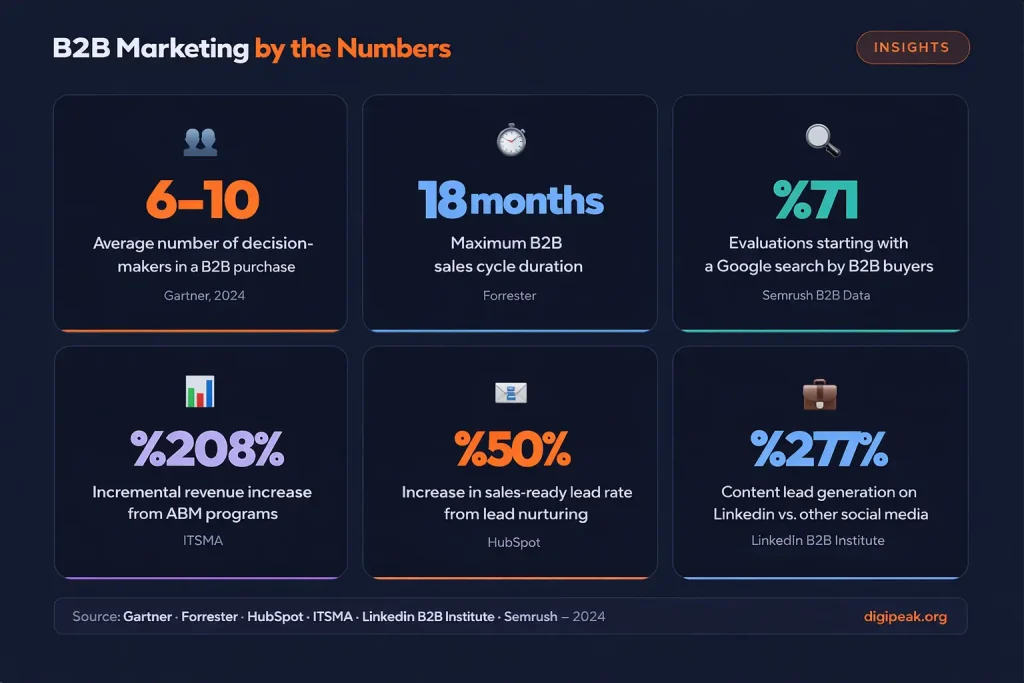
Business-to-business (B2B) marketing is fundamentally different from consumer marketing. Long sales cycles, multi-layered decision-making mechanisms, and high deal values make the B2B world a field of expertise in itself. According to Gartner research, B2B buyers need approval from an average of 6 to 10 decision-makers before making a purchasing decision. This complex structure reveals the necessity not of an ordinary digital marketing agency, but of a specialized partner that has internalized B2B dynamics.
In this guide, we will examine in detail what a B2B advertising agency is, which services it offers, current strategies, and the criteria you should pay attention to when choosing the right agency in 2026.
A B2B advertising agency is a specialized business partner that develops marketing strategies and advertising campaigns specifically for companies that sell their products or services not to individual consumers, but to other businesses. These agencies ensure that client companies reach the right buyers by having a strong understanding of sector dynamics, corporate decision-making mechanisms, and long sales cycles.
The main function of a B2B advertising agency is to conduct market analysis for the client company, define ideal customer profiles (ICP — Ideal Customer Profile), and design data-driven, multi-channel campaigns to reach these profiles. Building brand awareness, acquiring qualified leads, and establishing sustainable sales channels are the primary objectives of these agencies.
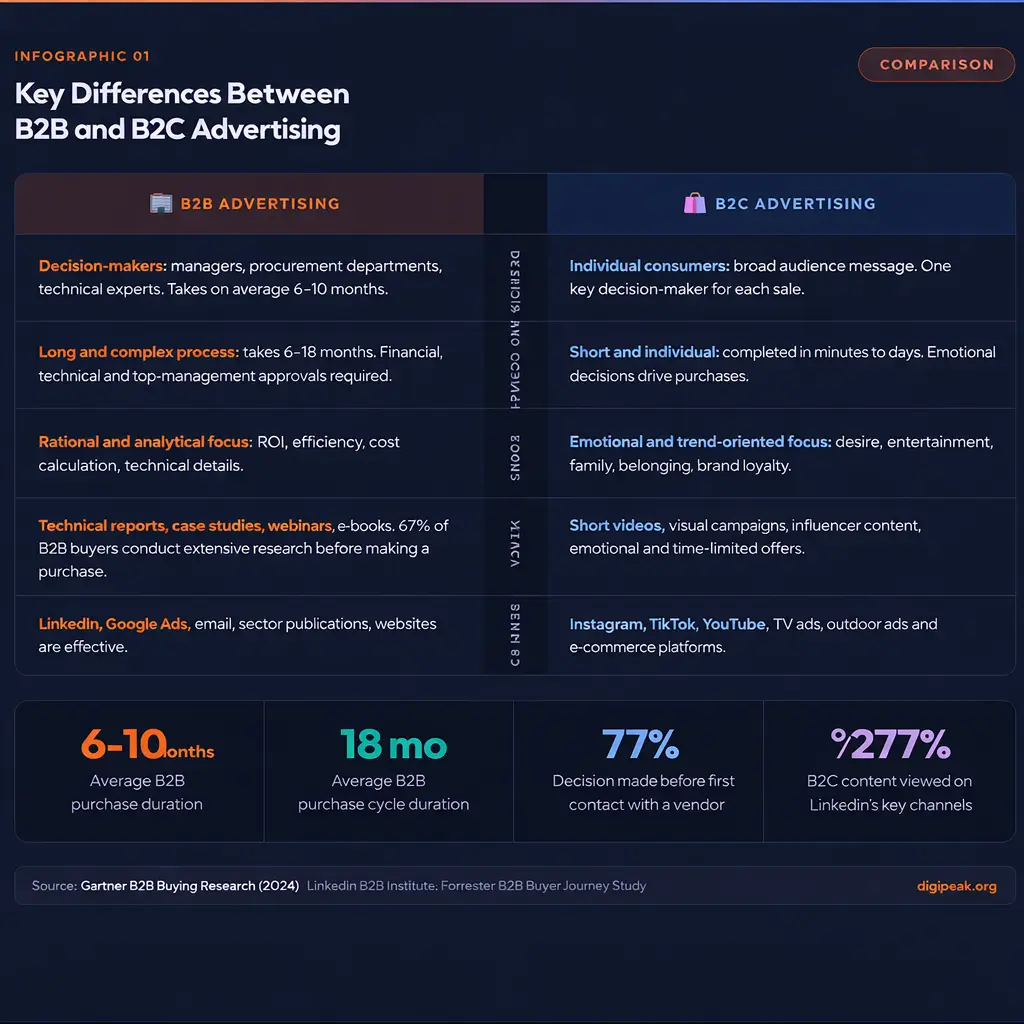
The difference between B2B and B2C advertising is not only seen in the target audience, but also in the communication style, decision-making process, and metrics used.
There are clear differences between B2B advertising and B2C advertising, ranging from the structure of the target audience to purchasing processes, from communication tone to content preferences. In B2B advertising, the target audience generally consists of in-company decision-makers and professionals; therefore, communication has a more rational and expertise-focused tone, and sales processes progress through long and detailed evaluations. In this model, communication channels such as professional networks like LinkedIn, email campaigns, and industry publications are prioritized, and content types with high information depth such as technical reports, case analyses, or webinars are used.
Success is evaluated through metrics such as qualified lead quality, cost of acquiring potential customers, and sales revenue, while the decision-making process usually takes weeks or months. In contrast, in B2C advertising, the target audience consists of individual consumers, and purchasing decisions are shorter, often emotional and based on immediate needs; therefore, communication is more emotional and trend-focused.
B2C campaigns are mostly carried out on mass-reach channels such as Instagram, TikTok, or TV, and attention-grabbing formats such as videos, visuals, or promotions are used as content. Success measurement is done through performance indicators such as reach, clicks, and number of sales, because in this model the consumer’s decision process is limited to minutes or days.
A B2B advertising agency provides end-to-end marketing services to help the client company achieve its goals. Below is a detailed breakdown of these services:
The agency conducts a comprehensive discovery meeting with the client to understand growth objectives, existing sales processes, and the competitive environment. As a result of target industry and competitor analysis, the ideal customer profile (ICP) is clarified. At this stage, it is determined which channels will be approached, with which messages, and with what budget, and a detailed marketing plan is created.
B2B buyers seek information and trust. To meet this need, the agency produces blog articles, e-books, technical reports (white papers), case analyses, infographics, and webinar content. According to research by the Content Marketing Institute, 91% of B2B companies use content marketing; however, only those that focus on content quality and strategic targeting can convert this into real customers.
The agency optimizes the technical infrastructure and content structure of the website. Site speed, mobile compatibility, meta tags, and page structure are reviewed. By identifying industry-specific keywords used by B2B buyers in search engines, organic visibility is increased. According to Semrush B2B data, 71% of B2B buyers start their evaluation process with a Google search.
Take Advantage of Automation with Artificial Intelligence!
How can you use your time more efficiently? Artificial intelligence saves you time by automating repetitive tasks. Learn how you can leverage AI to accelerate your business processes.
Paid advertising is the most direct way to reach the target audience. In Google Ads, targeting is done based on search intent; in LinkedIn Ads, precise targeting is applied based on criteria such as industry, company size, job position, and seniority. LinkedIn stands out as a unique platform for B2B lead generation: according to platform data, LinkedIn generates 277% more qualified leads for B2B marketers compared to other social media channels. Advertising copy, visuals, and targeting parameters are continuously optimized through A/B testing.
Is Your Ad Budget Flowing but Nothing in Return?
Get Free Ad Analysis with Digipeak!
Which campaigns are a waste of money? Are you spending unnecessary money? Where are the potential opportunities? We examine your ad performance in detail. Fill out the form now for a free analysis!
Potential customers obtained through digital campaigns are systematically tracked. When a visitor downloads an e-book or fills out a form, automated email sequences are activated. This “lead nurturing” process gradually guides the potential customer toward a purchasing decision. According to HubSpot research, companies that properly nurture leads generate 50% more sales-ready leads and do so at 33% lower cost.
ABM is the design of customized campaigns for a small number of highest-value target companies instead of advertising to a general audience. Personalized messages, content, and offer sets are prepared for each target account. According to ITSMA research, B2B companies that implement ABM achieve 208% higher revenue compared to traditional marketing.
Regular content sharing is carried out on relevant platforms, especially LinkedIn. Brand authority is built through participation in industry discussions, sharing expert articles, and community management. Comments and news about the company are monitored through online reputation tools, and proactive communication efforts are carried out when necessary.
The setup and management of tools such as HubSpot, Salesforce, and Marketo can be undertaken by the agency. Repetitive tasks are automated through automated email sequences, chatbots, and CRM integrations. This allows the sales team to focus on actual sales activities and the marketing team to focus on strategy development.
The results of all campaigns are monitored in real time through analytics tools. Metrics such as traffic, number of leads, conversion rates, CPL (cost per lead), and ROAS (return on ad spend) are shared through regular reports. With data-driven decisions, budgets are directed toward channels that provide the highest return.
B2B advertising agencies continuously follow innovation in order to stand out in competition. The main strategies and trends that come to the forefront in 2026 are as follows:
Artificial intelligence has now become an inseparable part of B2B marketing. Agencies accelerate processes such as content production, advertising optimization, and customer segmentation with AI tools. According to McKinsey, B2B companies that use AI in marketing and sales achieve a revenue increase of 10–20%.
Data-driven strategies have replaced intuition-based decisions. With data coming from Google Analytics, HubSpot, Semrush, and CRM systems, it is determined which content, which channel, and which message provide the highest conversion. Budgets are dynamically directed to platforms that deliver the highest ROI.
By tracking behavioral signals that indicate potential buyers’ purchase intent (website visits, content downloads, search queries), “hot leads” are prioritized. In this way, the sales team can focus on the most ready buyers.
B2B buyers conduct research across multiple channels. When LinkedIn, Google, email, industry publications, and webinars are used in an integrated manner, the brand appears at every touchpoint of the buyer. According to Demand Gen Report, 67% of B2B buyers use between 3 and 5 different channels before making a purchase decision.
Video has also become a powerful tool in B2B. Product demo videos, customer success stories, and webinars both increase brand authority and provide effective tools for lead generation. According to Wyzowl research, 78% of B2B marketers state that video contributes directly to sales.
Mass campaigns aimed at general audiences are being replaced by personalized content and messages based on the buyer’s industry, position, and purchase stage. According to Epsilon research, personalized experiences positively influence the purchasing decision of 80% of B2B customers.
One of the most important trends of 2025 is optimizing content not only for Google, but also for AI search engines such as ChatGPT, Gemini, and Perplexity. B2B decision-makers are increasingly using AI tools for research. Therefore, having your content appear as a source on these platforms has become a critical competitive advantage.
Different areas of expertise such as content writing, advertising management, SEO, and data analysis are brought together under one roof. Building this team internally is both costly and time-consuming. Working with an agency provides instant access to a ready and experienced team.
According to Aberdeen Group research, companies that outsource marketing activities operate at 43% lower cost compared to building in-house teams. Agencies apply tested strategies, minimizing trial-and-error costs.
Licensing costs for tools such as HubSpot, Semrush, Salesforce, Marketo, and Bombora are high. Since agencies already use these tools for multiple clients, you gain access to them without bearing the full cost.
Internal teams may have blind spots due to being too close to the product. An external agency sees how competitors position themselves, identifies market gaps, and provides unbiased analysis.
You can receive intensive support when launching a new product and later continue with a reduced scope in maintenance mode. Flexible project-based or retainer models allow dynamic budget management.
A good B2B advertising agency measures success not only through impressions or clicks, but through lead quality, conversion rates, and contribution to sales revenue. Transparent reporting is provided based on predefined KPIs.
B2B digital marketing is growing rapidly in Turkey. According to Statista data, Turkey’s digital advertising expenditures increased by 28% in 2024 compared to the previous year. As of 2024, LinkedIn’s user base in Turkey exceeded 15 million, demonstrating the value of reaching B2B decision-makers via LinkedIn.
The main challenges faced by B2B businesses in Turkey include difficulty in finding qualified leads, managing long sales cycles, alignment between marketing and sales teams, and the complexity of ROI measurement. All of these challenges fall within the solution scope of a specialized B2B advertising agency.
It is critical that the agency has worked in similar industries before. Different B2B sectors such as SaaS, manufacturing, logistics, or finance have unique sales dynamics, channel preferences, and messaging tones. Industry experience shortens the learning curve and produces faster results.
Review case studies and reference clients. Look for concrete data such as “increased organic leads by 120% in 6 months” instead of vague claims like “increased traffic.”
Examine which tools the agency uses. Does it have sufficient infrastructure in CRM, marketing automation, advertising management, and analytics? Can these tools integrate with your existing systems?
Choose based on your needs. If you require support across content, advertising, SEO, social media, and automation, a full-service agency is suitable. If you need support in a specific area, a specialized agency may be more efficient.
Clarify expectations regarding weekly updates, monthly reports, and real-time dashboard access from the beginning. Transparent and proactive communication is the foundation of long-term collaboration.
Evaluate whether retainer, project-based, or performance-based pricing suits your business. The cheapest agency does not necessarily deliver the best results. What matters is the expected return on investment.
B2B marketing is a cumulative investment. The agency should act as a long-term partner rather than a short-term service provider. Starting with a small project during the first 3 months is the healthiest way to test alignment.
Before meeting with an agency, prepare answers to the following:
Questions for your own team:
Questions to ask the agency:
These two concepts are often confused. A B2B digital marketing agency focuses solely on digital channels (SEO, social media, content, digital advertising), whereas a B2B advertising agency offers a broader scope. This scope may include traditional advertising channels (trade fairs, industry publications, printed materials), sales enablement tools, and CRM strategy.
However, today most B2B advertising agencies operate with a digital-first approach. Due to the superior measurability, targeting precision, and cost efficiency of digital channels, modern B2B agencies largely provide full digital integration.
Scenario:
A Turkey-based SaaS company was struggling to reach its target audience and generate qualified leads. Although the internal team continued to produce content, these efforts were not meaningfully contributing to the sales funnel.
Implemented Strategy:
Results (6 months):
This scenario demonstrates how integrated strategy, content, and paid advertising produce measurable B2B results.
Competition in digital marketing increases every day. In B2B, progressing with the right strategies is critical to achieving business goals.
As Digipeak Digital Marketing Agency, we offer proven expertise in B2B marketing. With experience across SaaS, finance, medical technology, and manufacturing sectors, we develop customized, 360-degree digital marketing strategies.
Data and transparency are at the center of our strategy. We track your marketing investments with numerical data at every stage and share regular reports. Our focus is not only on generating more leads, but on delivering measurable results that genuinely contribute to your sales pipeline.
If you want to strengthen your B2B sales channels and entrust digital marketing to professionals, contact us. Let’s explore your goals together and move your company to the next level of success.
What exactly is a B2B advertising agency?
A B2B advertising agency is a specialized partner that develops marketing strategies and advertising campaigns for companies selling products or services to other businesses. By understanding sector dynamics, long sales cycles, and corporate decision-making structures, it ensures client companies reach the right buyers.
Is a B2B advertising agency the same as a digital marketing agency?
Not exactly. While digital marketing agencies serve both B2B and B2C clients, B2B agencies specialize in areas such as LinkedIn targeting, lead nurturing, ABM, and long sales cycle management.
What are the advantages of B2B advertising agencies?
Key advantages include instant access to multidisciplinary expertise, up to 43% cost savings, access to advanced marketing technologies, objective external analysis, scalable service models, and KPI-based measurable results.
What is Account-Based Marketing (ABM) and why is it important?
ABM is a strategy that designs customized campaigns for high-value target companies instead of mass audiences. According to ITSMA, companies implementing ABM achieve 208% higher revenue.
Which digital channels do B2B agencies use?
LinkedIn, Google Ads, email marketing, organic SEO, industry publications, and webinars are the most commonly used channels.
Should small businesses work with a B2B advertising agency?
Yes. Especially for small businesses with limited internal marketing resources, agency support provides significant value. Starting with project-based or small retainer models is recommended.
How is ROI measured in B2B agency work?
KPIs are defined at the beginning. Metrics such as lead volume, CPL, conversion rate, sales cycle length, and ROAS are tracked through regular reporting.
In-house team or agency: which is better and when?
If you lack sufficient budget or time to build a full in-house team, outsourcing to an agency is more efficient. Hybrid models also work well.
Why is LinkedIn so important in B2B marketing?
With over 900 million users globally, LinkedIn enables precise targeting by industry, role, seniority, and company size, making it uniquely effective for reaching B2B decision-makers.
How are B2B agency fees determined?
Pricing models include retainer, project-based, and performance-based structures. Fees in Turkey vary from a few thousand to tens of thousands of TRY per month depending on scope. The key criterion is ROI, not price.
Why is GEO (Generative Engine Optimization) important in B2B marketing?
B2B decision-makers increasingly use AI tools like ChatGPT, Gemini, and Perplexity for research. GEO ensures your content appears as a trusted source within these platforms, creating a competitive advantage.
How does the B2B agency collaboration process work?
The typical process includes discovery, ICP and strategy definition, creative production, campaign execution, regular reporting and optimization, and strategy updates. Initial results usually appear within 90 days.

Join the
Digipeak Newsletter!
Stay up to date with the latest digital marketing insights, trends, and updates. Subscribe today!
Related Articles
Social media advertising has become a game of speed, creativity, and constant testing. Brands are …
In today's fast-paced digital world, deciding between an in-house marketing team and a specialized agency …
Most companies that invest in LinkedIn Ads don't get the results they expected, not because …
The digital retail environment is no longer defined by simple keywords and blue links. It …


