
Best AI Tools for Making Social Media Ads at Scale
Social media advertising has become a game of speed, creativity, and constant testing. Brands are …


 ★★★★★ 5.0 · 100+ reviews







Table of Contents
MEET OUR TEAM!
Most companies that invest in LinkedIn Ads don’t get the results they expected, not because LinkedIn advertising doesn’t work, but because they hired the wrong LinkedIn Ads agency, or hired one before they understood what “the right agency” actually looks like. The platform reached 1.20 billion advertising-reachable members by early 2025, and B2B ad budgets flowing into it jumped from 31% to 39% of total social ad spend in a single year. That growth trajectory means more agencies are now calling themselves LinkedIn specialists. Most of them are not.
Before you sign a contract, hand over budget, and wait three months for a pipeline that never materialises, you need a clear-eyed framework for evaluating what you’re actually buying. This guide gives you exactly that.
LinkedIn advertising is not Facebook or Google with a professional skin. The targeting logic, the creative requirements, the attribution windows, and the bid mechanics are fundamentally different. An agency that runs excellent performance campaigns on other platforms will not automatically produce results here without platform-specific experience.
Consider the numbers: the average cost-per-click on LinkedIn sits between $5 and $10, compared to roughly $1 on Facebook. Average customer journeys on LinkedIn run 320 days — significantly longer than on other paid channels — because the B2B buying cycle the platform serves is inherently complex and multi-stakeholder. A campaign optimised for cheap clicks will bleed budget. A campaign engineered for pipeline influence and long-cycle nurture will compound in value over time.
The platform’s power is undeniable when used correctly. LinkedIn accounts for 80% of all B2B leads generated through social media, generates 277% more leads than Facebook and Twitter combined for B2B companies, and delivers a 28% lower cost per lead than Google Ads in B2B contexts (Sprout Social). For SaaS companies specifically, research shows LinkedIn can produce a 2.44x to 6.01x pipeline ROI when campaigns are built with full-funnel architecture.
Pay attention to this section — it defines everything that follows: whether an agency can talk intelligently about what makes LinkedIn different is your first qualification filter.
These are not aspirational qualities — they are baseline requirements. Any agency that cannot demonstrate all seven is not yet equipped to manage serious LinkedIn advertising spend.
A LinkedIn Ads agency worth hiring will immediately be able to describe how they structure campaigns across awareness, consideration, and conversion stages. The platform’s ad formats — Sponsored Content, Message Ads, Lead Gen Forms, Dynamic Ads, Conversation Ads, Document Ads — each serve different funnel stages. Ask any agency you evaluate: “How do you allocate budget across funnel stages, and why?” A vague answer here is disqualifying.
The best agencies think in terms of Account-Based Marketing (ABM) architecture. ABM campaigns on LinkedIn deliver 200% better ROI according to published benchmarks — because they focus precision ad delivery on a defined set of target accounts rather than scattering spend across a broad audience. Ask whether the agency has ABM experience and how they’ve structured it for clients with similar deal sizes to yours.
LinkedIn’s targeting capability is the core reason the platform commands a premium CPC. You can reach prospects by job title, function, seniority, company size, industry, skills, group membership, and company growth rate. Narrowing an audience to under 50,000 highly relevant professionals increases CTR by 37% compared to broad targeting — but it requires a clear segmentation strategy, not just ticking boxes in the platform.
Ask the agency to walk you through how they would build an audience for your specific ICP (Ideal Customer Profile). They should discuss Matched Audiences (uploading your CRM contact lists or account lists), website retargeting through the LinkedIn Insight Tag, and engagement-based retargeting. If they don’t mention these three levers without prompting, their platform depth is probably surface-level.
This is where the most campaigns quietly fail. LinkedIn users scroll their feed with a professional mindset, not a consumer one. Creative that works on Instagram — lifestyle imagery, emotional hooks, short punchy copy — typically underperforms in a professional feed where the reader is evaluating decisions with commercial consequences.
The data is clear: video ads under 15 seconds retain 75% of viewers, carousel ads with 5–7 cards outperform single-image formats, and ads using professional imagery see 25% higher engagement. Document ads (native PDFs) drive 2.5x higher engagement than standard posts. An agency should be able to explain which format serves which objective and why, and they should show you examples of creative they’ve actually produced.
In a campaign we ran for a SaaS client targeting VP-level prospects in the financial services sector, switching from lifestyle-style imagery to clean, data-forward creative — a simple stat on a branded slide — increased CTR by 41% within two weeks. The creative didn’t shout louder; it spoke the audience’s language. Most LinkedIn creative mistakes come from agencies applying consumer brand logic to a B2B context. The professional feed rewards relevance and specificity, not emotional loudness.
🔵 Peaker Note
Take Advantage of Automation with Artificial Intelligence!
How can you use your time more efficiently? Artificial intelligence saves you time by automating repetitive tasks. Learn how you can leverage AI to accelerate your business processes.
LinkedIn Lead Gen Forms have a 13% average conversion rate and reduce cost per lead by 20% compared to sending traffic to external landing pages. But a form submission is not pipeline. The agency’s responsibility doesn’t end when a lead enters your CRM — it extends to how that lead is qualified, what happens in the 107-day average gap between MQL and SQL stages, and how LinkedIn retargeting keeps brand presence alive during that window.
Ask the agency: “What happens after someone fills out a Lead Gen Form?” Their answer will tell you whether they think in acquisition terms only — or whether they understand the full revenue lifecycle. B2B purchase decisions involve an average of 6.8 stakeholders; a LinkedIn strategy that only captures one contact and then disappears is structurally incomplete.
Is Your Ad Budget Flowing but Nothing in Return?
Get Free Ad Analysis with Digipeak!
Which campaigns are a waste of money? Are you spending unnecessary money? Where are the potential opportunities? We examine your ad performance in detail. Fill out the form now for a free analysis!
Clicks, impressions, and cost-per-click are operational metrics. What you actually need to know is how LinkedIn spend influenced pipeline creation, opportunity value, and closed revenue. The agency should offer reporting that connects ad exposure to downstream business outcomes — or at minimum, explain how to build that connection through your CRM integration.
LinkedIn’s Conversions API (CAPI) is now essential for accurate attribution. According to LinkedIn’s own published data, CAPI integration delivers a 20% lower cost per acquisition and 31% more attributed conversions compared to pixel-only tracking. If the agency you’re evaluating doesn’t mention CAPI in their measurement conversation, they are working with incomplete data — and so will you.
The platform’s ad product suite evolves continuously. Agencies that were strong three years ago may not have kept pace with newer formats like Thought Leadership Ads, which amplify content published by specific employees rather than brand pages, or Conversation Ads (where regulations allow), or the evolving AI-powered creative optimisation tools LinkedIn is rolling out for regional audience adaptation.
Ask specifically about Thought Leadership Ads — they perform exceptionally well in 2025 because the LinkedIn algorithm favours personal content over brand content. An agency that builds this into their content strategy has a current, platform-native approach. One that relies only on standard Sponsored Content is leaving meaningful reach on the table.
LinkedIn advertising has a meaningful minimum effective budget. Below approximately $3,000–$5,000 per month in ad spend, the learning algorithm doesn’t have enough signal to optimise bid strategy, and the audience sizes required for statistically meaningful testing are often too small to generate reliable conclusions.
Any agency that tells you LinkedIn will “work great” at $500 a month is not being honest with you — or they don’t understand how the platform’s bidding and learning phases actually function. An agency worth hiring will give you a frank budget floor based on your objectives and target audience size, and they will explain what’s achievable within it — not just validate whatever number you’ve already decided on.
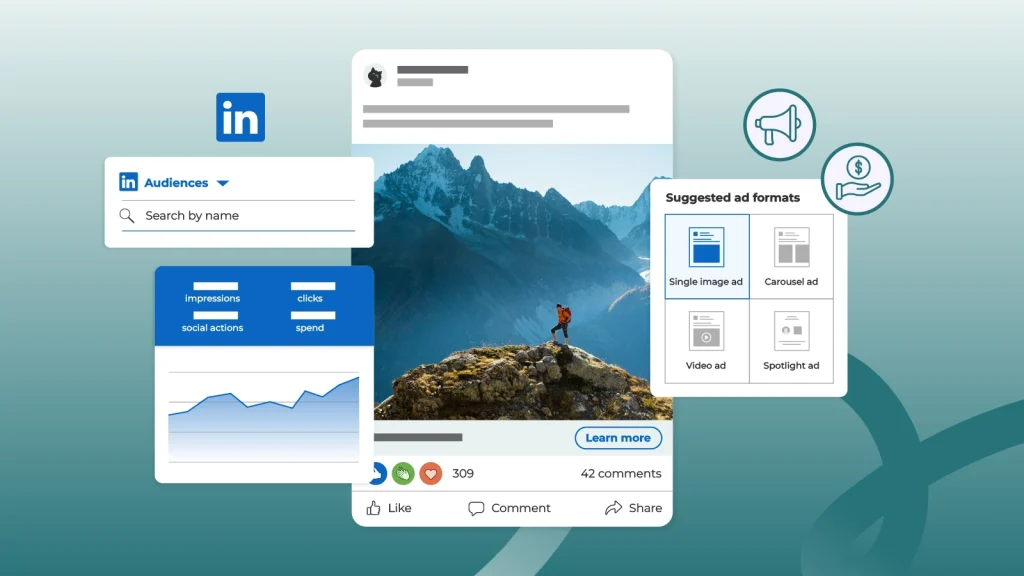
The average CPC on LinkedIn is $5.39, with the range stretching from $5 to $20+ for highly competitive audiences like C-suite technology executives. CPM runs around $33 on average. These costs are higher than most other paid social platforms — and that context matters when you’re evaluating an agency’s pricing model.
Here is the cost breakdown most agencies won’t put on their proposal decks:
Before signing, ask for a full cost breakdown that separates all five categories. You should know exactly what percentage of your total investment is reaching your audience, and what percentage is going to agency overhead. A reasonable benchmark: for every £/$1 in management fees, at least £/$3–4 should be going toward actual media spend for campaigns to have enough scale to generate meaningful data.
The ROI case is strong when budgets are correctly allocated. LinkedIn’s average ROAS is approximately 113%. Brands that advertise consistently see a 2–3x increase in brand perception. Exposure to LinkedIn ads increases purchase intent by 33%. But these returns require correct campaign architecture, appropriate budget allocation, and time — the average B2B buying journey influenced by LinkedIn runs 320 days, not 30.
The following five-step process reduces the risk of a misaligned engagement before any contract is signed. It takes effort — but significantly less effort than three months of underperforming campaigns.
The data tells a clear story: 65% of B2B marketers say LinkedIn delivers the highest ROI of any social platform, yet a significant share of companies running LinkedIn Ads report disappointing results. The gap between platform potential and actual performance is almost always explained by one of four structural problems:
Mismatched objectives and ad formats. Running Lead Gen Form campaigns to build brand awareness, or running brand awareness campaigns to generate immediate pipeline, are both structurally wrong. Each format is algorithmically optimised for a specific outcome.
Audiences that are too broad or too narrow. Campaigns aimed at audiences above 500,000 in a target geography can waste 90% of budget on irrelevant users. Conversely, audiences under 10,000 may not have enough volume for the algorithm to exit the learning phase.
Creative that doesn’t match the professional context. LinkedIn users are evaluating ideas, not just scrolling. Creative that succeeds on consumer platforms will frequently fail here because it doesn’t match the evaluative mindset of a professional audience mid-work-day.
Attribution windows that are too short for B2B cycles. LinkedIn’s influence on a deal often appears as an impression — not a click. Standard last-click attribution dramatically undervalues the platform’s contribution. The 2025 Dreamdata Benchmarks Report shows LinkedIn influences 29% of MQLs, 36% of SQLs, and 35% of new business deals — even when those touchpoints don’t appear in click-based attribution models.
Three findings from this guide are worth internalising before your next agency conversation.
First: LinkedIn advertising works — but the margin for structural error is low. The platform’s premium CPCs and long attribution windows mean that misallocated budget doesn’t just underperform in the short term; it produces misleading data that can lead to further bad decisions. Precision at the setup stage is not optional.
Second: the right agency asks more questions than they answer in your first meeting. Agencies that immediately propose a solution without deeply understanding your ICP, your sales cycle, your average contract value, and your current CRM state are solution-first rather than problem-first. That orientation rarely produces enterprise-grade results.
Third: LinkedIn’s role in B2B pipeline is increasingly non-negotiable. With 80% of B2B social leads originating on the platform, a share of B2B ad budgets that hit 39% in 2024 and is projected to grow further, and account-based marketing delivering 200% ROI uplift, companies that haven’t yet built a systematic LinkedIn advertising function are building a structural disadvantage. The question is not whether to invest, but how to invest correctly.
At Digipeak, we approach LinkedIn advertising as a revenue engineering problem, not a campaign management task. Our starting point is always the same: understanding your pipeline architecture, your ICP in granular detail, your sales cycle, and the commercial outcome that needs to result from paid media investment. Only then do we build campaign structure.
As a Google and Meta partner agency with offices in London, Istanbul, and Texas, we have managed over $5M in paid ad spend across SaaS and B2B clients across multiple markets and verticals. Our team combines deep platform expertise with commercial thinking — we report on pipeline influence and revenue attribution, not just clicks and impressions. We integrate LinkedIn’s Conversions API as a standard part of every engagement because measurement accuracy is not a premium feature; it’s a foundation.
Our B2B and SaaS specialisation means we build LinkedIn campaigns with the complexity that enterprise buying cycles require: account-based audience architecture, multi-format creative strategies aligned to funnel stage, and reporting frameworks that make LinkedIn’s contribution to revenue visible even across 200+ day attribution windows. Our 100+ clients have seen LinkedIn shift from “channel we’re trying” to “pipeline engine we depend on.”
If you’re evaluating LinkedIn Ads agencies and want a direct, no-commitment conversation about what a correctly structured programme would look like for your business, we’ll give you a clear picture in 15 minutes.
A LinkedIn Ads agency plans, builds, manages, and optimises paid advertising campaigns on LinkedIn on behalf of a client. This includes audience strategy and targeting, ad creative production, campaign setup across formats such as Sponsored Content, Lead Gen Forms, and Message Ads, bid management, conversion tracking, and reporting. Specialist agencies also handle attribution integration, ABM account-list management, and CAPI setup.
A realistic minimum effective budget for LinkedIn advertising is $3,000–$5,000 per month in media spend for campaigns to generate enough data for meaningful optimisation. Below this threshold, the platform’s learning algorithm doesn’t receive sufficient signal, and audience sizes are often too small for statistical reliability. For enterprise B2B campaigns targeting senior decision-makers in competitive verticals, $10,000–$20,000 per month is more appropriate.
Initial performance data typically becomes available within 4–6 weeks of campaign launch. However, because the average B2B customer journey influenced by LinkedIn spans 320 days, meaningful pipeline impact is often visible at the 60–90 day mark for lower-value deals, and 6+ months for enterprise contracts. Attribution windows should reflect this — 30-day windows dramatically undercount LinkedIn’s true contribution to revenue.
Most LinkedIn Ads agencies charge either a percentage of ad spend (typically 15–25%), a fixed monthly management retainer, or a hybrid of both. Creative production, strategy consulting, and reporting tools may be included or charged separately. Before signing, request a full cost breakdown that separates agency fees from media spend. A healthy ratio is roughly $3–4 in media spend for every $1 in management fees, though this varies by campaign complexity.
For B2B companies with deal sizes above $5,000–$10,000 ACV, LinkedIn advertising consistently delivers strong ROI when campaigns are correctly structured. The platform accounts for 80% of all B2B social leads, generates 277% more leads than Facebook for B2B purposes, and SaaS-focused campaigns have produced 2.44x to 6.01x pipeline ROI in published research. The higher CPC ($5–$10 average) is typically justified by the quality and commercial relevance of the audience reached.
LinkedIn advertising requires platform-specific expertise that general social media agencies often lack. The bidding mechanics, audience segmentation depth, ad format selection logic, attribution windows, and creative strategy for professional audiences are fundamentally different from consumer platforms. A specialist LinkedIn Ads agency will have direct experience with ABM architecture, Conversions API integration, Insight Tag setup, and Lead Gen Form optimisation — capabilities that go well beyond standard social media management.
Accurate ROI measurement on LinkedIn requires three components: LinkedIn’s Insight Tag for website activity tracking, Conversions API (CAPI) integration for connecting ad exposure to CRM and revenue data, and a reporting framework that uses attribution windows of 30–90 days or longer for B2B sales cycles. The most useful metrics are pipeline influenced, cost per SQL, and cost per closed deal — not just CPL or CTR. Agencies integrating CAPI report 20% lower CPA and 31% more attributed conversions compared to pixel-only tracking.

Join the
Digipeak Newsletter!
Stay up to date with the latest digital marketing insights, trends, and updates. Subscribe today!
Related Articles
Social media advertising has become a game of speed, creativity, and constant testing. Brands are …
In today's fast-paced digital world, deciding between an in-house marketing team and a specialized agency …
The digital retail environment is no longer defined by simple keywords and blue links. It …
Business-to-business (B2B) marketing is fundamentally different from consumer marketing. Long sales cycles, multi-layered decision-making mechanisms, …


