
Best AI Tools for Making Social Media Ads at Scale
Social media advertising has become a game of speed, creativity, and constant testing. Brands are …


 ★★★★★ 5.0 · 100+ reviews








Table of Contents
MEET OUR TEAM!
Let’s learn how businesses use email not only to communicate with customers but also to sell their products and services. Email marketing is a powerful form a digital marketing. It’s a useful automated tool that businesses can use to build relationships with their customers and drive leads and sales.
Email marketing is a digital marketing and communication strategy that typically involves sending emails to customers and potential customers to provide information about company news or product and service sales. It is the best digital media tool that not only attracts and retains customers but also enhances brand loyalty. “Email” is one of the most effective channels of digital marketing.
For example, a user visits the My Travel Guide website to look for tips on how to plan a budget-friendly trip to Europe. They find the information they need and are about to leave the site.
However, before leaving, they see a pop-up inviting them to subscribe for travel tips and exclusive travel deals. In this scenario, they need to enter their name and email address and agree to receive the newsletter. (Bingo!)
Now, the company can establish a dialogue with the customer. The subscriber may receive helpful emails, such as a monthly newsletter featuring top travel destinations, packing tips, or itineraries for different budgets. Periodically, promotional messages may also be sent, offering special discounts on travel packages or early booking deals for flights.
Alternatively, the user may subscribe to an email series focused on a specific topic. For instance, a series titled “Guide to Budget Travel in Europe” could be sent over a few weeks. This series could include tips on finding cheap flights, affordable accommodations, and budget-friendly activities. It may also contain promotions, such as discounts on travel consultancy services.
Both methods mentioned above are referred to as warming-up techniques by marketers. Regular newsletters and targeted email series help maintain ongoing engagement with users, build trust, and encourage them to take advantage of the offered services.
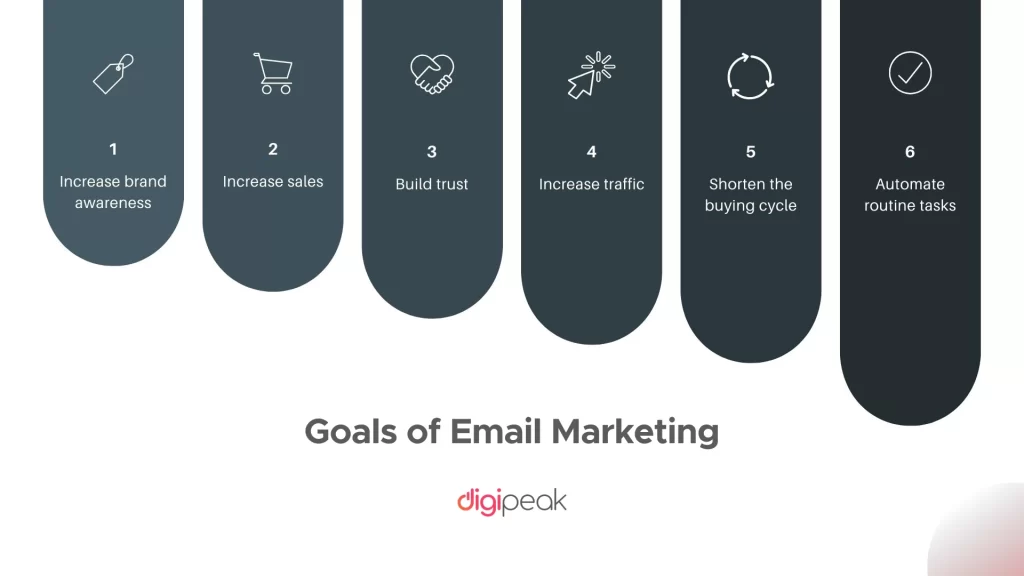
A well-planned email marketing strategy can help you achieve both long-term and short-term goals. Let’s take a look at them:
With email marketing, you can establish lasting relationships with your customers. While advertisements are a way to sell, email marketing is the only way to connect with people on a personal level, inform them about what matters to them, and guide them toward the best course of action. If you treat your readers with care in every email, you will soon move beyond being just another business selling products.
Email newsletters are a great way to remind customers about your brand. The more frequently they see your company’s newsletter in their inbox, the more likely they are to choose you when looking for a product. Remember, promotional campaigns alone won’t help you create the right brand image in your customers’ minds—combine promotional emails with educational content.
Acquiring new customers is often more expensive than retaining existing ones. Subscribers who receive newsletters are more likely to return to your website and make another purchase. A Gigaom survey found that 56% of participants considered email marketing the most effective tool for customer retention.
Take Advantage of Automation with Artificial Intelligence!
How can you use your time more efficiently? Artificial intelligence saves you time by automating repetitive tasks. Learn how you can leverage AI to accelerate your business processes.
You can achieve this through email newsletters. Be honest and transparent—customers appreciate that. Include reviews and testimonials in your emails so subscribers have proof of your brand’s credibility. You can also provide a link to a testimonial page on your website. Make sure to add a testimonials section for each product category.
Is Your Ad Budget Flowing but Nothing in Return?
Get Free Ad Analysis with Digipeak!
Which campaigns are a waste of money? Are you spending unnecessary money? Where are the potential opportunities? We examine your ad performance in detail. Fill out the form now for a free analysis!
According to the UK Data & Marketing Association (DMA), every $1 invested in email marketing generates an average of $42–$44 in sales. Email marketing is 40 times more effective than Facebook and Twitter in attracting new customers.
You don’t need much effort to achieve this goal. Each email contains links to specific pages on your website, so if you craft an engaging subject line and a relevant offer, customers will click on the links. This way, you can drive traffic to popular pages or promote less-visited ones.
Email marketing helps customers make decisions at every stage of the buying process. When selling complex or expensive products, customers often take time to decide. Through emails, potential buyers can learn more about you and your business, ultimately helping them choose you.
By using email newsletters, you can provide valuable resources and educate your customers. This effort contributes to projecting your company as an expert in the eyes of buyers, which in turn improves their perception of your brand.

The goals of email marketing go far beyond simply sending messages to a list. From a strategic standpoint, especially when aligned with objectives like increasing brand awareness, boosting sales, and automating tasks, email marketing serves as a critical engine for customer engagement and business growth.
| Goal | How Email Marketing Achieves It |
|---|---|
| Increase Brand Awareness | Frequent, branded communication keeps your business top-of-mind |
| Boost Sales | Direct promotions, personalization, abandoned cart recovery |
| Build Trust | Helpful content, transparency, customer stories, social proof |
| Drive Traffic | Strategic CTAs to blog posts, landing pages, and events |
| Shorten the Purchase Cycle | Nurture sequences, triggers, timely offers |
| Automate Routine Tasks | Workflows for onboarding, re-engagement, and transactional messages |
The most important thing is to understand why you need email marketing. However, setting goals doesn’t stop there. Ensure that each goal is:
If you’ve decided to include email newsletters in your marketing plan, use this guide. It will help you through the process of building your first email list and provide practical advice on how to develop long-term relationships with your readers.
This is one of the most crucial steps. The effectiveness of your email strategy depends on the quality of your mailing list. Communicating with people who are genuinely interested in your brand is the only way to succeed. Additionally, an email list can include names, genders, cities of residence, subscription dates, and other subscriber-provided details. You can use this data to create relevant and personalized campaigns.
Getting consent from subscribers is critical when collecting email lists. If people haven’t given permission to receive emails from you, never buy mailing lists. They are not interested in your brand and may classify your emails as spam, damaging your sender reputation. Instead, create a subscription form, place it on your website, and legally collect subscribers.
To improve open rates, click-through rates, and overall conversion rates, use segmentation to enhance the relevance of your email list. Segmentation in email marketing involves grouping your subscribers based on factors like gender, interests, customer inquiries, and activities. Marketers can then send personalized emails based on these factors.
Users tend to engage more with emails from brands that use segmentation, leading to higher open rates. Send emails based on customer activities to create a personalized experience.
Before segmenting, you need an email list built using the data from your subscription form. The more customer data you collect, the more precisely you can segment your list, increasing the relevance of your newsletters.
This stage involves multiple steps. First, create a plan listing all the emails you want to send this month. This helps you:
A lead magnet is a piece of value-driven content offered to website visitors in exchange for their email address. Common formats include templates, frameworks, industry reports, calculators, audits, swipe files, and short email courses. Its purpose is to acquire qualified subscribers by giving them an immediate, tangible benefit that signals the value your brand will keep providing after signup.
Most teams optimize the visible part of list building: the popup, the form, the call to action. The invisible part is the offer itself, and that is where the conversion actually happens. Industry benchmarks place average email signup conversion rates between 1% and 3% for general site traffic. Programs with strong lead magnets routinely operate at 8% to 15% on the same traffic. The difference is not the form. It is what the form is offering.
The mechanism is simple. A visitor weighs the offer against the perceived cost of their email address, the spam risk, and the time it takes to consume the asset, then decides whether the trade is worth it. When the offer is generic (“Subscribe to our newsletter”), the trade is bad. When it is specific and tangible (“Get the pricing template we use with B2B SaaS clients”), the trade is good. Readers have evaluated thousands of these trades and have become fast at telling genuine value from filler.
The economics are worth making explicit. If traffic costs you $2 per visitor to acquire, a 2% signup rate puts your cost per subscriber at $100. An 8% rate on the same traffic puts it at $25. Most teams never connect their signup conversion rate to their cost per subscriber, so the inefficiency stays invisible while the budget keeps getting spent.
Four criteria show up consistently in lead magnets that perform.
Specificity over breadth. The instinct is to build the most comprehensive resource possible: “The Ultimate Guide to Email Marketing.” That instinct is wrong. Comprehensive guides signal breadth, and breadth signals dilution. A narrowly named asset such as “The 7-Email Welcome Sequence for Service Businesses” converts far better than a broad one on the same topic. Specificity does two things at once: it makes the visitor recognize themselves in the offer, and it makes the promised result concrete rather than abstract.
Time-to-value under 15 minutes. A 60-page ebook competes for hours of attention and usually loses, ending up unopened in a downloads folder. A four-page checklist, a simple template, or a calculator can be used within ten minutes of download. This matters beyond the signup: a lead magnet someone actually used produces a subscriber who opens the next email, while one they ignored produces a subscriber who disengages within 30 days.
Tangible deliverable format. Templates, calculators, frameworks, checklists, scripts, and audit tools consistently outperform “tips” or “guides” of the same length. The reason is psychological. A template feels like something the reader can use and adapt; a list of tips feels like advice available anywhere. Production cost is often lower too, because the value sits in the structure rather than in polished prose.
Alignment with the job the reader is doing. The strongest lead magnets attach to a task the audience is working on right now: setting up a pricing page before a sales cycle, writing a promotional email before Friday, preparing for a first call with an account. The most common failure is producing an asset aligned with what the brand wants to talk about rather than what the audience is trying to accomplish.
Each model carries a different production cost, audience fit, and downstream subscriber quality. Choose based on what your audience is trying to do, not on what is easiest to make.
| Lead Magnet Type | Typical Conv. Rate | Production Effort | Best For |
|---|---|---|---|
| Templates and frameworks | 8–12% | Low (4–8 hrs) | B2B, SaaS, services |
| Industry reports and benchmarks | 6–10% | High (40+ hrs) | Authority building |
| Calculators and interactive tools | 10–15% | Medium–High (20–60 hrs) | Decision-stage buyers |
| Email courses | 4–7% | Medium (15–25 hrs) | Educational / onboarding |
| Free audits and diagnostics | 12–18% | Custom per audit | High-intent commercial |
| Swipe files and asset libraries | 9–14% | Low–Medium (10–15 hrs) | Marketers, creatives |
| Mini-books and specialized guides | 3–6% | High (30–50 hrs) | Thought leadership only |
| Newsletters and communities | 5–9% | Ongoing operational | Long-term authority |
Templates and frameworks are the highest-ROI category for most service and B2B businesses, because they collapse the gap between “I want to do X” and “I have started doing X” to almost nothing. They also self-segment: someone downloading a pricing page template is at a different stage than someone downloading a welcome email template.
Industry reports work only when they contain proprietary data that does not exist elsewhere. Reports recycling publicly available statistics do not perform. The production cost is high, but a strong report keeps acquiring subscribers for several quarters and supports PR and sales enablement at the same time.
Calculators and interactive tools produce the highest conversion rates of any category because they deliver personalized output rather than generic information, creating a sense of value before the email is even submitted. Calculator users also tend to sit closer to a buying decision than general content readers.
Email courses work when the topic genuinely benefits from sequencing, so the reader can act on each step before the next arrives. They also build the open habit early. Forcing a five-day course out of content that should have been a checklist creates friction instead.
Free audits are the highest-intent category for service businesses. The asset delivers value and the follow-up conversation surfaces commercial intent, which is why audits produce subscribers with materially higher lifetime value than generic downloaders.
Swipe files collect high-performing examples: ad copy, subject lines, landing pages, email designs. They work especially well for marketer and founder audiences. The real work is curation and annotation. Fifty annotated examples beat fifty unexplained ones.
Mini-books work in narrow circumstances only: a genuinely deep topic, an audience that reads, and real authority behind the byline. Eight to fifteen focused pages with a clear point of view converts; a sprawling generic ebook does not.
Newsletters and communities can be the magnet themselves when the publication has a strong editorial position. Operating cost is ongoing rather than one-time, but subscribers acquired this way self-select for engagement and produce a higher-quality list over time.
Even a strong lead magnet underperforms if it is placed badly. Five placements matter most.
Homepage placement captures visitors arriving through brand or paid traffic. The asset here should be your broadest one, answering the most common entry-point question.
Blog post placement, or content upgrades, produces the highest conversion rates, because the asset can be matched to the specific topic of the article. Someone reading about welcome sequences should be offered a welcome sequence asset, not a generic newsletter signup. Topic-matched content upgrades routinely convert at several times the rate of site-wide popups.
Dedicated landing pages suit high-value assets you can send paid traffic to directly. They allow deeper messaging, stronger imagery, and more social proof than an inline placement can carry.
Exit-intent popups still work, though less reliably than they once did. They perform best when the offer matches what the visitor was just reading. Generic exit popups offering a blanket discount or a newsletter subscription produce low-intent subscribers.
Embedded inline forms earn fewer signups per impression but produce better subscribers, because the visitor has read enough to understand the brand and chose to subscribe deliberately rather than reactively. For content-led growth, inline forms are often the highest-value placement.
The principle underneath all five: one universal lead magnet usually underperforms three contextually placed ones. Producing three matched assets does not cost three times as much, because the work compounds. Once the first strong asset exists, the second and third come together much faster.
Decide how often you will send newsletters and specify this in your plan. It’s recommended to let subscribers choose how often they want to receive emails, which can be included in the subscription form or emails.
Next, determine the types of emails you’ll send over the next month. It’s important to maintain a balance between promotional and non-sales emails so that subscribers don’t feel bombarded. No subscriber wants daily sales reminders—mix them with triggered and transactional emails.
Triggered emails are sent automatically in response to user actions, such as:
Almost all of these emails have a high click-through rate (ctr) because users have started sending these emails themselves, so they expect to receive this or that campaign.
Transactional emails are also sent to subscribers based on their actions. The difference between any marketing email and a transactional email is that the latter’s goal is not to convert a user into a customer. Its purpose is to retain customers and build trust. Order confirmation, delivery status, plan upgrade, password reset and many other emails are examples of transactional emails.
Remember that trigger and transactional emails cannot be scheduled, so plan accordingly. If you plan to send three emails a week and a customer browses products on your website, adds them to their cart, places an order and registers for a webinar, you will send them at least four more emails each week, or a total of seven emails per week.
Now that you know which emails you want to send and how often, it’s time to get started.
If you’ve never done it before, you need to get used to sending emails from a known IP address. This means you have no reputation yet, and if you send 5,000 emails to an entire mailing list, you risk being flagged as a spam sender.
Email providers need to recognize you as a legitimate sender. Only then will your emails reach the inbox. Therefore, building a sender reputation can take 4-8 weeks.
We recommend creating an email template that matches your brand’s style. You can use this every time you send out a newsletter.
Look at how many people opened your newsletter and clicked on the links leading to your website. Check if there were any requests or sales, if applicable. Regularly receiving statistics on the effectiveness of your efforts is one of the advantages of digital marketing. This information can be quite helpful while refining your marketing strategy and looking for more effective ways to connect and engage with your target audience.
With email marketing solutions, you can track important metrics like open rates, click-through rates, and conversion rates. Moreover, many solutions allow you to run A/B tests comparing the results of two different campaigns to identify the characteristics of high-performing emails.
By regularly analyzing your data and conducting experiments, your entire email marketing strategy will perform better. Additionally, as you collect more data, you can create email templates that generally work well for your company, boosting your efficiency in subsequent campaigns.
Use the following tips to make your emails as powerful as possible:
The subject line of your email holds the secret to winning over a potential customer. The subject can only contain up to 20 characters. Ensure it reflects the content of the email and is both visually appealing and relevant. It’s crucial to make sure your readers aren’t disappointed when they open your email.

Segment your target audience based on factors like location, gender, age, and preferences. By implementing these strategies, you can ensure your subscribers receive the most useful information.
It should take about 11 seconds to read an email. This way, the email will be both interesting and sufficiently informative.
Remember, it should contain a clear call to action like “Yes, I want to subscribe” or “Buy Now.”
Now, let’s look at the most important elements users consider when deciding whether to open your email: the sender’s name and subject line. These are the first things subscribers see when they receive your campaign.
First and foremost, avoid using addresses like “no*****@*BC.com.” There are a few standards to follow. These types of addresses don’t help you connect with your audience; they appear robotic and impersonal.
Instead, use your company’s name in the sender’s address. You can also include the name of the person responsible for email communication with the audience or the department sending the emails. This gives your customers a chance to reach out to your business.
Since it helps build brand awareness, carefully consider your sender name. There are many practical options, with using your company’s name being the first and safest choice. This way, your subscribers will quickly identify the sender.
Now, let’s address the second item users see in their emails—the subject line. It gives users the basic details of the email. You should reflect the campaign’s content in the subject line. In addition to providing information, your goal should be to attract subscribers and encourage them to read your newsletter.
Here’s an example of an educational email subject line. The subscriber is invited to listen to a podcast. By reading only the subject line, the reader already knows the visitor’s job title and the topic.
When writing an email, the first thing to keep in mind is that you’re writing for your target audience, not for yourself. Never use email to tell your readers how great your brand is. People are more interested in finding simple answers to their problems than in hearing about brands. Provide them with your solution and explain how it solves their issues.
To achieve this, write in a clear, concise manner. Be mindful of your readers’ time; they have a lot to do aside from reading your newsletters. 🙂 The best option is to keep it short. Stick to the inverted pyramid paradigm to make your writing as readable as possible. This means starting your email with the most important information and ending with a call to action.

Since the average user’s attention span is only eight seconds, stick to a single-column layout, as they won’t read your message from A to Z. Use white space around key elements like headlines and calls to action to help subscribers easily focus on important things.
Include only one CTA button per email. The call to action (CTA) is what you want your subscribers to do after reading your campaign. If you use three CTA buttons in a single campaign, it can confuse the reader as each one diverts attention from the main message. To create an effective CTA, be clear, and use limited text. It should give clear instructions on what the user should do next. Make the button stand out against the background, so recipients can quickly identify it.

Allow people to click on the image. Almost all users click on an image while reading an email. Direct them to the appropriate webpage. Since some email clients might not display images, always include alternative text for every image you add. This way, users will see the descriptive text for the images.
Make sure the subject of your email is clear for both beginners and experts. Therefore, avoid using too much slang and jargon. What you’re discussing should be clear to everyone.
Create an appropriate email footer. Although it might not be directly related to your message, it contributes to brand trust and should still be carefully considered. Known as the email signature, this component includes the following details: justification for the recipient of the email, an unsubscribe link, a link to the control center for newsletter settings, your company’s physical address and logo, copyright information, and social media links.


Ensure the unsubscribe link is easily accessible; don’t use small font sizes or hide it within the text. The unsubscribe process should only require one step and should be easy for the user to complete. This helps improve the quality of your email list.
Statistics show that businesses send an average of two to four emails per day. So how can you structure the ideal email frequency? Here are a few tips:
You can offer options on the registration form to receive emails daily, weekly, or monthly.
Adjust the frequency based on the information you gather.
Some users find promotional emails with discounts or offers interesting, while others believe emails with educational material are more useful. Let your subscribers choose the information they are interested in and send emails accordingly.
Test the open rates of your emails by sending them to two equal groups at different times. Adjust your email list based on the results.
Signup conversion rate tells you how many visitors joined the list. It does not tell you whether they were worth acquiring. Track three metrics together instead of one.
Initial signup conversion rate measures how many visitors enter the list. Sixty-day engagement rate measures what share of those subscribers are still opening emails two months later. Revenue per subscriber measures whether the list produces business value at all.
The distinction matters because these metrics frequently disagree. An asset that signs people up at 12% but loses 70% of them within 60 days produces worse list quality than one that signs up at 5% and keeps 70% engaged. A lead magnet performing well on signup rate alone is a vanity win that does not translate into revenue.
Also known as split tests, A/B tests allow you to evaluate the performance of various versions of your email by making small changes to a single component.
Rather than following your instincts about marketing efforts, A/B testing is essential for making data-driven decisions. Split test options that allow you to test each section of the email separately are available from most email service providers. Summary of the metrics you can test:
E-commerce email marketing runs on segmentation more than on volume. Three segmentation approaches drive most of the results.
Lifecycle stage divides subscribers by where they sit in the customer journey, whether that is awareness, consideration, or decision. Emails are then matched to the stage rather than sent uniformly to everyone.
Past purchase behavior segments by previous orders, order value, or product category, which is what makes genuinely relevant recommendations, cross-sells, and upsells possible.
Abandoned cart recovery uses automated workflows to remind shoppers about items left behind, address the objection that stopped them, and offer help or an incentive to complete the purchase. It is consistently the highest-return automated flow in e-commerce email.
Email marketing automation allows marketers to work more efficiently with fewer resources. It involves delegating daily responsibilities like processing orders and sending a series of welcome and follow-up emails to an email service.
Email marketing automation helps you save money and time, allows you to focus on more important tasks, dedicate more time to strategy development, increase sales, improve customer loyalty and retention, and offer targeted messages to your audience by better understanding their needs.
The lead magnet is the visible asset. What follows it determines whether the subscriber stays subscribed and engages with anything you send afterwards.
The confirmation email is the first message a new subscriber receives and the most-opened email you will ever send them, with open rates above 80% being typical. It should deliver the asset clearly, set expectations for what comes next, and include one specific next action, such as inviting a reply about which part of the asset was most useful.
The welcome sequence that follows usually runs four to seven emails over seven to fourteen days. The structure that works is not “Email 1: Welcome, Email 2: About Us, Email 3: Products.” The structure that works is: how to actually use the asset, then a specific result someone else achieved with it, then an adjacent problem the reader also has, then the connection between the asset and what you sell.
Time-to-first-value measures how quickly a subscriber gets a useful outcome from being on your list. Subscribers whose first two weeks include a tangible outcome, such as applying the template or completing the audit, retain at significantly higher rates than subscribers whose first two weeks were brand-focused emails.
Re-engagement triggers catch subscribers before they fully disengage. Someone opening fewer than 30% of emails in their second month will usually be a non-opener by month four unless something intervenes. These sequences should fire on engagement signals, not on calendar schedules.
To increase team efficiency, email marketers often use various email marketing platforms and technologies. These platforms offer advanced features that can help you create personalized emails, maintain your contact list, send automated emails, and track your email marketing campaigns while implementing your marketing plan.
Platforms differ less in features than in what they are built around, so the useful question is fit rather than ranking.
The right choice depends on how much automation complexity you actually need and whether email needs to sit inside a broader system or run standalone.
The benefits of email marketing are undeniable. To achieve good and long-lasting results, it is important to follow the best practices for marketing posts.
Some marketers collect email address databases from various sources—LinkedIn, event participant lists, other address databases, and sometimes from personal connections—and send emails for various purposes. This often results in recipients immediately deleting your emails, making it a poor email marketing strategy. Violations of data privacy laws like CAN-SPAM and GDPR (General Data Protection Regulation) can also lead to this. Before starting your email marketing efforts, you should get your subscribers’ consent to receive your emails.
GDPR is a data protection regulation in the European Union. It requires websites to inform users that they are managing personal data. Marketers should use a two-step subscription form to ensure that users confirm their subscription requests twice. Additionally, you should review your privacy policy—get permission to collect customers’ personal data, explain how you store and share it, and ensure that third parties cannot access it.
If readers no longer find your material or company interesting, they should be able to unsubscribe from the newsletter. Best practices for email marketing suggest that you make it easy to unsubscribe by clearly placing the unsubscribe button or link. If you force readers to subscribe to your newsletters against their will, they will likely stop receiving your emails.
Potential consumers and customers entrust their email addresses and sometimes other personal information when they subscribe to your newsletters. It is unethical to share or sell their emails to third parties without their permission.
When building your email list, place each new subscriber or customer into appropriate categories. Customers can be categorized by geographical location, hobbies, or other factors that are relevant to both your company and the customers. If your list is poorly segmented, your emails will be less successful and will lead to irrelevant emails being sent to subscribers.
Write a welcome letter for every new subscriber. The welcome email serves to introduce your company’s features, style, messages, character, and values to potential customers. Inform them about the topics and frequency of upcoming newsletters, as well as your availability for questions and suggestions on relevant and helpful resources.
Some subscribers may stop being active over time. This can happen for reasons ranging from decreased interest in your product or service to email address changes. Regularly clean inactive subscribers from your list to keep it up-to-date. This helps maintain high email deliverability, click-through rates, and open rates. However, before removing inactive subscribers from your list, try engaging them one last time. Send them a targeted email asking if they still wish to receive information from you.
Mobile devices are where most people view their emails. If your marketing efforts are not mobile-friendly, you are missing a big opportunity. Keep mobile users in mind when planning your emails. Make sure that the images in your newsletters load quickly and are compatible with mobile devices. If your newsletters contain videos, publish them on websites like Vimeo or YouTube and provide readers with links. Here are some additional suggestions for improving your marketing campaigns:
Keep in mind that your customers may view your emails on various hardware and browsers. Test your marketing emails to ensure they work and appear as intended. If you don’t test your emails on different devices and browsers, you may find broken links or oversized graphics in your emails. Send yourself a test email to check how it looks.
Although buying email address databases may seem like a good idea, it actually isn’t. In reality, the only people who should receive your marketing newsletters are those who truly want them. Before doing this, verify that you have received permission from all potential customers and consumers to send them newsletters. You can use a subscription form on your website or other lead-generation strategies to obtain these addresses.
A new IP address should be warmed up before sending emails from it. Gradually increase the amount of email you send to prove to the email provider that you are a legitimate sender. ISPs (Internet Service Providers) believe a sender is spamming if they notice that a large number of emails are being sent from a new IP address. As a result, emails may end up in the spam folder.
Gradually increase the volume of emails you send to improve your sender reputation and email deliverability, targeting the most interested consumers. The warming process typically lasts 4 to 8 weeks. After this, your deliverability will improve, and ISPs will see you as a trusted sender.
Create a policy to check all emails for spam before sending them. If the subject line contains too many exclamation marks or spam-related terms, the deliverability of your newsletter will be very low. Therefore, at the end of developing an email campaign, make sure the email is not marked as spam.
Sending emails without considering how successful they are is a waste of time. You should be aware of how well the strategies and approaches that yield the best results are performing. To evaluate your effectiveness, track your KPIs. Monitor email deliverability, open rates, click-through rates (CTR), bounce rates, unsubscribe rates, and conversion rates.
An effective email campaign starts with a high-quality mailing list. First, you need to collect user addresses. After that, you should periodically evaluate the quality of your list. See how subscribers are responding to your emails. If they haven’t responded to your newsletters for three to six months, and re-engagement emails don’t work, remove them from your list.
There is no benefit in expressing sympathy for people who are not interested in your business. By doing this, you can maintain strong deliverability and sender reputation because emails will not be flagged as spam
Brands can save time and money by implementing automation for more important tasks. You can send automatic emails in response to user behavior on your website using different services. Assign a newsletter service to carry out tasks such as order confirmations, reactivating inactive customers, welcoming new users, and others. Create events that will trigger emails to be sent automatically. Use conditions and filters to send relevant campaigns. Track conversions and improve your processes.
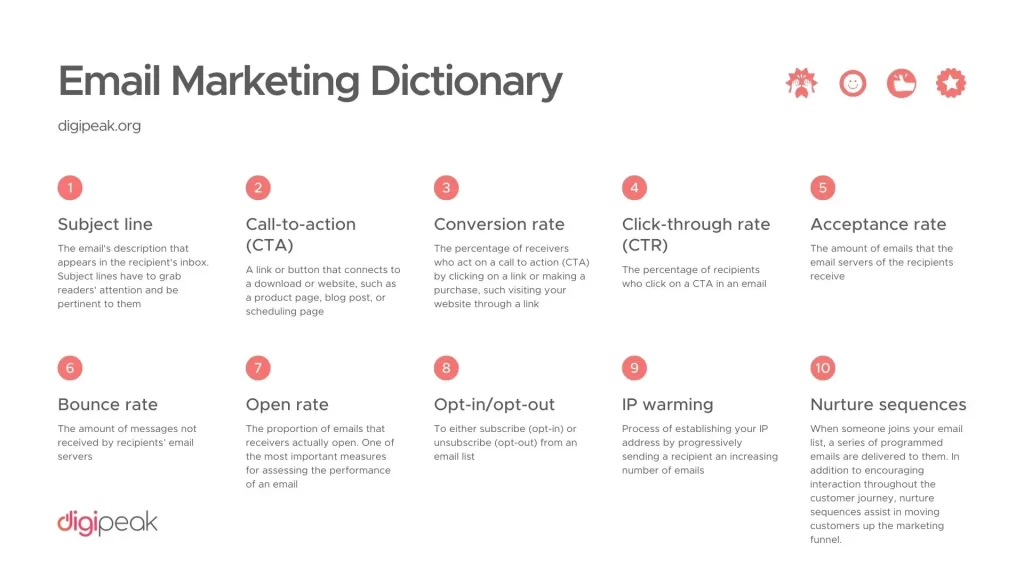
Digital marketers use various terms to describe the email marketing process. Here’s a glossary of some important concepts you should familiarize yourself with:
Subject Line: The description of the email that appears in the recipient’s inbox. Subject lines should grab the reader’s attention and be relevant to them.
Call-to-Action (CTA): A link or button that connects to a download, product page, blog post, or scheduling page.
Conversion Rate: The percentage of recipients who take action on a call-to-action (CTA), such as making a purchase or visiting your website by clicking a link.
Click-Through Rate (CTR): The percentage of recipients who click on a CTA in an email.
Acceptance Rate: The amount of emails received by the recipient’s email servers.
Bounce Rate: The amount of messages not received by the recipient’s email servers.
Open Rate: The percentage of emails actually opened by recipients. This is one of the most important metrics for evaluating an email’s performance.
Opt-in/Opt-out: Subscribing to (opt-in) or unsubscribing from (opt-out) an email list.
IP Warming: The process of establishing your IP address by gradually sending an increasing number of emails to a recipient.
Welcome Emails: When someone joins your email list, they receive a series of scheduled emails. In addition to encouraging engagement throughout the customer journey, welcome emails help move customers up the marketing funnel.
The success of marketing campaigns depends on a well-executed email marketing strategy. If you continue to learn and keep up with the times, your strategies will remain effective and efficient. Stay updated on the latest trends, experiment with various strategies, and adjust your tactics based on data-driven insights.
Your email marketing efforts can enhance consumer relationships, increase engagement, and yield remarkable results if you dedicate the necessary time and creativity. Never forget that every email you send is an opportunity to captivate your readers and advance your long-term success. Keep moving forward, and you’ll see a boom in email marketing!
By integrating email marketing into your digital marketing strategies, you can build stronger relationships with your target audience, increase your brand’s visibility, and significantly boost your sales.
At Digipeak, we’re here to help you on your email marketing journey.
With our free e-book and comprehensive blog posts, you can learn the basics of email marketing, create your campaign with consulting services from our experts, and achieve your goals with our email marketing strategies.
Take action now and discover the power of email marketing! Explore our mail marketing services.
Remember, email marketing is one of the most effective digital marketing tools for your business’s growth. Use email marketing to its fullest potential with Digipeak, increase your sales, and achieve success!

Join the
Digipeak Newsletter!
Stay up to date with the latest digital marketing insights, trends, and updates. Subscribe today!
Related Articles
Social media advertising has become a game of speed, creativity, and constant testing. Brands are …
In today's fast-paced digital world, deciding between an in-house marketing team and a specialized agency …
Most companies that invest in LinkedIn Ads don't get the results they expected, not because …
The digital retail environment is no longer defined by simple keywords and blue links. It …


