









AEO Ethics & Trust: Provenance, Citations & Safety Rules
If you are reading this, you have likely noticed that the digital environment has shifted …

29/05/2023 -
13 dk okuma
Stay up to date with Peakers
In today’s fast-paced digital environment, artificial intelligence (AI) is radically altering how organizations function and compete. Artificial intelligence (AI) is having a revolutionary effect on practically every facet of business, from automating mundane jobs and boosting decision-making to increasing consumer experiences and opening up new revenue sources. Generative artificial intelligence and machine learning for business develop every day.
Learn how Generative AI (ex: ChatGPT) is changing the face of business in ground-breaking ways. The effects of artificial intelligence (AI) are far-reaching and diverse, ranging from optimizing operations and generating new insights to altering customer interaction. Find out how organizations of all sizes and in a wide variety of fields can use AI for businesses to get ahead and thrive in the next AI-driven world.

There are numerous ways in which AI is affecting corporate life. The automation of routine chores is a major factor in the new environment. As a result, output is up and expenses are down. Customer satisfaction has increased thanks to the application of AI in providing individualized service. Artificial intelligence is also being utilized to enhance decision-making by illuminating hidden information.
The ability of artificial intelligence to automate mundane and time-consuming jobs is a major boon to businesses since it allows human workers to focus on more valuable, intellectually challenging tasks. AI-powered chatbots, for instance, can handle routine customer support inquiries, freeing up human agents to deal with more challenging situations that require empathy and problem-solving abilities.
Artificial intelligence (AI) can also help businesses learn more about their operations and their consumers, allowing them to make better decisions and provide more personalized products and services. AI’s ability to sift through mountains of data and spot trends, possibilities, and patterns that people might overlook is giving firms a leg up in the marketplace. However, there are difficulties associated with implementing AI.
Artificial intelligence (AI) will have a profound effect on the future of work. While automation may render some occupations obsolete, new opportunities requiring expertise in data analysis, machine learning, and natural language processing will emerge as a result of advances in AI. Businesses and employees alike stand to gain from AI’s anticipated enhancements to productivity, cost savings, and decision-making. ChatGPT is one of many platforms that are currently being used to save time and increase productivity on many departments.
AI in the workforce is also influencing workplace dynamics. The use of AI-powered tools has enhanced productivity and decreased expenses by automating formerly manual processes. Artificial intelligence in the workplace is also being utilized to facilitate better teamwork among employees. Employee performance and happiness in the workplace have both grown as a result of AI-facilitated individualized learning opportunities.
The potential impact on employment is a major cause for concern, as AI has the ability to either completely replace or significantly augment human labor in many settings. There may be a need for upskilling and reskilling programs to help workers remain competitive in a labor market where some jobs may become outdated while others require new skills and training.
There are also some drawbacks to artificial intelligence, despite the positive impact of ai. The potential adverse effect on the labor market is a major source of concern. Some jobs may go extinct if AI is able to fully automate them. On the other hand, AI is predicted to provide new employment opportunities that will call for specialists in data analysis, machine learning, and natural language processing.
AI is likely to play an ever-increasing role in determining the course of employment and commerce in the future. AI and business have the potential to revolutionize the way businesses function and grow in the future by, among other things, automating repetitive tasks, enhancing customer relationships, and revealing previously hidden insights and opportunities.
Take Advantage of Automation with Artificial Intelligence!
How can you use your time more efficiently? Artificial intelligence saves you time by automating repetitive tasks. Learn how you can leverage AI to accelerate your business processes.
AI enables brands to deliver deeply personalized experiences by analyzing intent signals such as browsing patterns, dwell time, and recent searches. Businesses can map these signals to a decision engine that dynamically changes page layouts, chat prompts, and offers. The result? Real-time personalization that increases engagement and conversion rates while building lasting customer loyalty.
Low-code automation tools now allow teams to eliminate repetitive work—like email triage, data entry, or report generation—without requiring advanced coding. By freeing employees from mundane tasks, organizations can focus human effort where it matters most: creativity, strategy, and customer care. The measurable result is reduced turnaround time and significantly lower operational costs.
Pairing process-mining analytics with AI helps businesses detect inefficiencies across workflows. Event logs and process graphs reveal exactly where time is being lost—whether it’s delayed approvals, inventory restocking, or client onboarding. Once identified, these patterns guide optimization efforts that shorten cycle times and improve service delivery by up to 40%.
AI accelerates innovation when experimentation becomes structured. Businesses can adopt a two-week “AI sprint” model—define a problem, prototype an algorithm or model, test on users, and decide whether to scale or pivot. These mini-experiments bring agility and data-driven clarity to product development and digital transformation initiatives.
AI-powered analytics platforms help companies move from data collection to data storytelling. By using machine learning to identify patterns, forecast demand, and detect anomalies, organizations can make faster, more confident decisions. This empowers teams across departments to leverage insights without needing data-science expertise.
Traditional robotic process automation (RPA) can be brittle and costly to maintain. A better approach is event-driven automation, where lightweight bots act on specific triggers instead of fixed scripts. This composable model scales efficiently, adapts quickly to change, and dramatically reduces maintenance overhead.
AI-powered learning platforms are revolutionizing professional development. Personalized learning paths and virtual tutors adapt content to each employee’s skill gaps and progress rate. This accelerates workforce readiness, enhances digital literacy, and builds confidence in using AI tools—creating a culture of innovation and continuous learning.
AI can digest vast amounts of social media, review, and customer-support data to uncover emerging trends and unmet needs. Automated sentiment analysis and topic clustering allow companies to identify new product opportunities, monitor competitors, and predict market shifts before they happen.
Beyond dashboards and KPIs, explainable analytics provides “the why” behind performance shifts. By surfacing cause-and-effect insights—such as why certain customer segments churn—leaders can act decisively. Integrating interpretability into analytics fosters transparency, accountability, and faster executive buy-in.
AI accelerates hiring by screening resumes, matching candidates to job criteria, and predicting cultural fit. When paired with human oversight, it improves speed without compromising fairness or diversity. This hybrid approach reduces bias, shortens time-to-hire, and enhances candidate experience.
Modern AI tools empower every department to access insights responsibly. Role-based access control, automated metadata tagging, and clear data policies ensure that analytics remain both open and secure. True data democratization reduces bottlenecks and increases data literacy across the organization.
Decision intelligence bridges the gap between analytics and execution. By combining model outputs with playbooks and guardrails, companies can operationalize decisions—whether it’s pricing, logistics, or marketing optimization. The result is consistent, measurable improvement in strategic decision-making.
AI enhances cybersecurity through behavioral analytics, anomaly detection, and automated incident response. By continuously learning from patterns of normal activity, AI systems can identify intrusions faster and reduce false alarms. This shortens mean-time-to-detect and strengthens overall digital resilience.
AI helps finance and procurement teams control costs by analyzing spending patterns and identifying optimization opportunities. Automated spend clustering and supplier scoring highlight inefficiencies, prevent duplicate purchases, and improve contract negotiations—leading to measurable savings and stronger financial health.
AI transforms marketing by generating multiple ad variations, analyzing performance data, and suggesting winning combinations. Creative teams can then refine top-performing concepts while maintaining brand integrity. This cycle of rapid testing and learning drives higher ROI and smarter ad spend.
AI doesn’t just optimize; it measures what truly drives results. Tracking KPIs like automation coverage, cycle time, and cost per transaction allows leaders to focus on measurable outcomes. With AI-powered monitoring, organizations can identify inefficiencies early and continuously refine their processes for sustained growth.
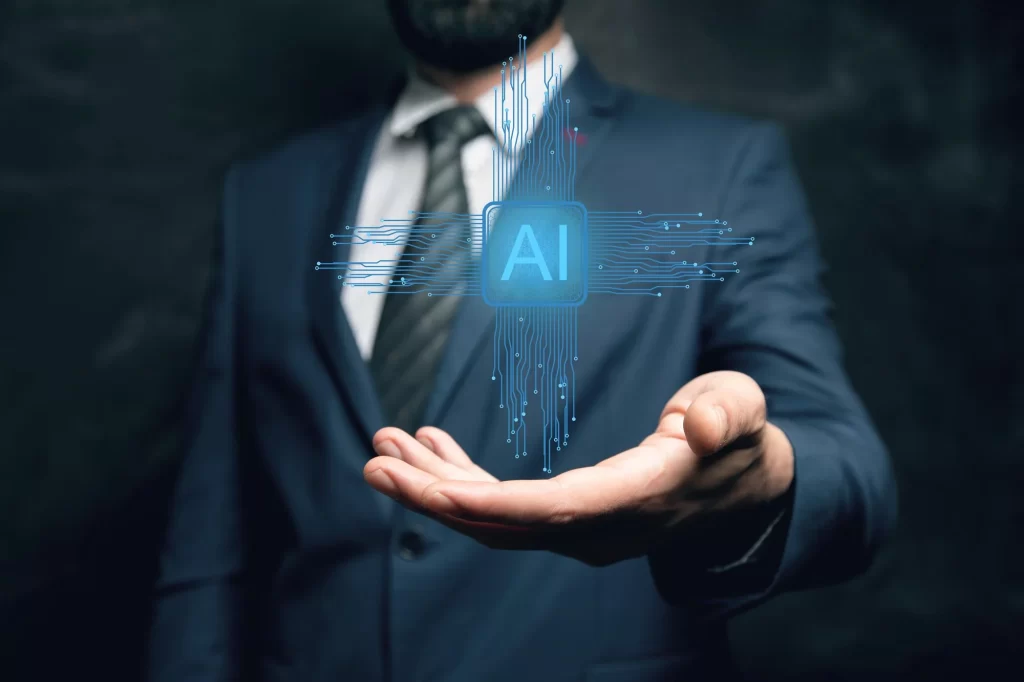
Experts agree that AI will have far-reaching consequences in the future, altering nearly every facet of human existence. Future trends that can be attributed to artificial intelligence include:
In conclusion, AI has far-reaching and diversified effects on business, with major efficiency, productivity, and innovation benefits for those who use it. To make sure AI is used for the greater good, however, it’s important to accept it with prudence, taking into account the potential problems and hazards, and adopting ethical practices. This will put companies in a good position to take advantage of the opportunities presented by AI in the future.
Several crucial variables have contributed to AI’s meteoric rise in recent years, such as artificial intelligence in business:
In order to learn and enhance their effectiveness, AI systems necessitate massive amounts of data. The development of big data technologies and the widespread use of digital devices and sensors have made it possible to create increasingly powerful AI algorithms.
In order to handle massive datasets and carry out complex computations, AI algorithms need access to a lot of processing power. Training and running AI models at scale has become possible with the advent of high-performance computing technologies like graphics processing units (GPUs) and distributed computing systems.
Deep learning algorithms are a type of machine learning that aim to mimic the way the human brain operates through the use of artificial neural networks. The impressive results achieved by these algorithms in fields as diverse as picture identification and natural language processing have stimulated the creation of increasingly complex AI systems.
Machine learning is currently the most widely utilized form of AI. Machine learning is a branch of artificial intelligence that includes educating computers to learn from data by teaching them to recognize patterns and draw conclusions or make predictions. Image identification, NLP, predictive analytics, and recommendation engines are just some of the many areas where machine learning has found usage.
In the corporate world, artificial intelligence has many potential uses, including but not limited to customer service, operations management, and even marketing. However, the following are some of the most exciting applications of artificial intelligence used in business:
AI systems can sift through mountains of data in search of trends and patterns, allowing organizations to better anticipate future events. Businesses can benefit from AI-driven forecasting in a number of ways, including better meeting customer demand and streamlining supply chain operations.
Customization AI can be used to customize products and services to each customer’s unique tastes and preferences. For instance, chatbots can deliver customized customer support interactions, and AI-powered recommendation engines can promote products based on a user’s browsing and purchasing behavior.
Businesses can avert financial losses by using AI algorithms to monitor transactions in real time for signs of fraudulent activity. To investigate possible fraud, AI-driven systems can examine transaction data for anomalies and raise red flags accordingly.
There are many ways in which AI may help DevOps teams:
Companies of all sizes and in all sectors are embracing AI technologies to boost internal operations, decision-making, and customer service. AI is revolutionizing the business world by boosting efficiency, productivity, and creativity by automating mundane jobs and providing greater insights into customer behavior.
Businesses face opportunities and threats from increasingly advanced and autonomous AI. Responsible AI methods can help limit possible negative repercussions, while upskilling and reskilling programs can help employees adapt to a shifting labor environment. Despite these obstacles, it is evident that AI has positive implications for businesses. AI is likely to play an ever-increasing role in determining the course of employment and commerce in the future.
Organizations need to anticipate changes and capitalize on opportunities using AI to survive in today’s dynamic market. At Digipeak, as a creative team, we are dedicated to assisting organizations in maximizing their potential through the strategic implementation of innovative AI technology.
Get in touch with us today to find out more about how we can assist your company in utilizing the game-changing potential of AI to maintain a competitive edge.
Get an Offer


Join Us So You Don't
Miss Out on Digital Marketing News!
Join the Digipeak Newsletter.
Related Posts
If you are reading this, you have likely noticed that the digital environment has shifted …
In an industry that moves at the speed of culture, staying still means falling behind. …
Do you recall when "Artificial Intelligence" in e-commerce was little more than a basic chatbot? …
The year is 2026. The digital marketing playbook from just a couple of years ago …


