
Retention Metrics: Which to Track by Business Model (Formulas + Benchmarks)
Most teams track the wrong retention metric for their business, then wonder why the number …


 ★★★★★ 5.0 · 100+ reviews








Table of Contents
MEET OUR TEAM!
The term retention marketing gets used interchangeably with at least six other terms it is not the same as. Loyalty marketing, lifecycle marketing, performance marketing, remarketing, retargeting, and acquisition marketing all overlap with retention in some way, and the loose usage causes real confusion when teams try to assign budget, hire specialists, or set goals. A team that cannot articulate how retention differs from remarketing will usually end up funding one while thinking it is buying the other.
This guide is a plain-English disambiguation hub. It defines retention marketing once, then places it side by side with each of the six terms it is most often confused with, explaining what actually differs and when each approach is the right one. The goal is not to argue that retention is better than the others. It is to make the distinctions clear enough that you can decide which one a given problem actually calls for.
The short version, before the detail: retention marketing is about keeping and growing the value of customers you already have. Most of the terms it gets confused with are either a subset of that goal, a channel used to reach it, or the opposite side of the funnel entirely. Knowing which is which is the whole point.
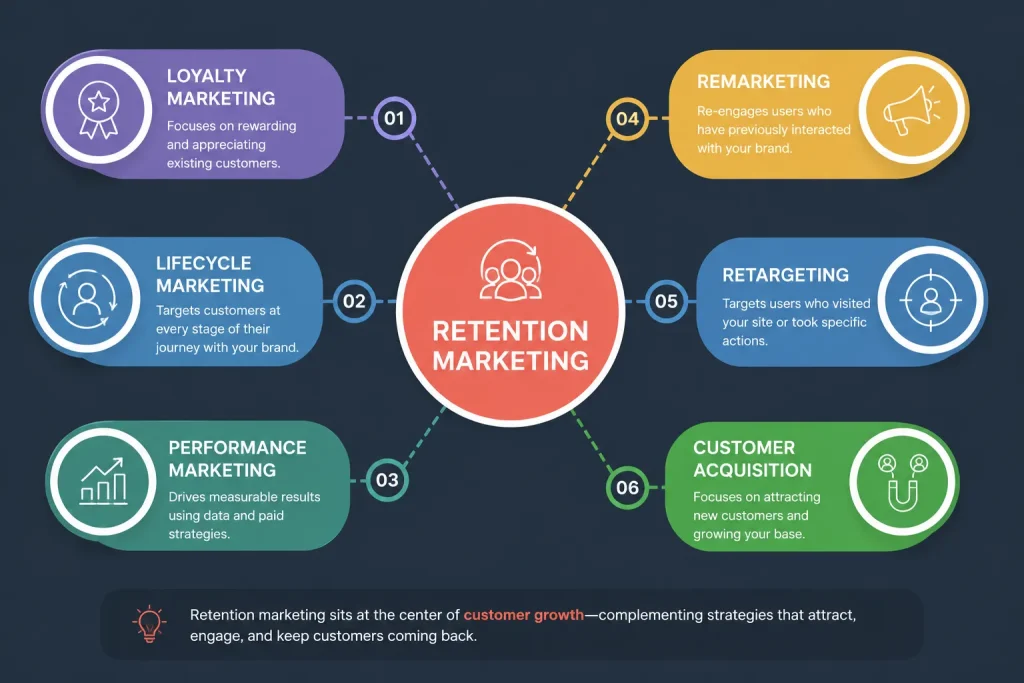
Retention marketing is the coordinated practice of increasing revenue per acquired customer over time through systematic engagement across the customer lifecycle. It is the work that begins after a customer is won: bringing them to their first value moment, deepening their engagement, preventing them from churning, and winning them back when they lapse. Its defining characteristic is its focus on existing customers rather than new ones.
Retention marketing matters because keeping a customer is consistently cheaper than acquiring a new one, and small improvements in retention compound into large revenue gains over time. This guide focuses on how retention differs from adjacent disciplines; for the full framework, economics, channels, and KPIs, the complete retention marketing guide is the cornerstone resource. Here, the job is disambiguation.
| Term | How It Relates to Retention | Core Difference |
| Loyalty marketing | Subset of retention | Rewards and programs, one tool inside retention |
| Lifecycle marketing | Overlapping superset | Covers the whole journey, including acquisition |
| Performance marketing | Method, not a goal | Measurement model that can serve either goal |
| Remarketing | Channel used by retention | Re-engaging via email/ads, often existing customers |
| Retargeting | Acquisition-leaning channel | Ads to past visitors, usually not yet customers |
| Acquisition marketing | The opposite side | Winning new customers, before retention begins |
Loyalty marketing is a subset of retention marketing. Loyalty marketing specifically uses rewards, points, tiers, and membership programs to encourage repeat purchases and deepen the customer relationship. Retention marketing is the broader discipline that includes loyalty programs as one tool among many, alongside onboarding, engagement campaigns, churn prevention, and win-back.
The practical distinction: every loyalty program is retention marketing, but not all retention marketing is a loyalty program. A well-designed onboarding sequence retains customers without any points or rewards involved. A win-back campaign re-engages lapsed customers without a membership tier. Loyalty is a powerful retention tactic, particularly in consumer and e-commerce contexts, but treating the two as identical leads teams to think a points program is a complete retention strategy when it is one component of one.
When each applies: reach for loyalty marketing specifically when repeat-purchase frequency is the core lever and a structured reward gives customers a reason to consolidate spend with you. Think about retention marketing as a whole when the problem is broader than repeat purchases, which it usually is.
Lifecycle marketing is a broader superset that overlaps heavily with retention but also includes acquisition. Lifecycle marketing organizes all marketing around the stages a customer moves through, from first awareness to advocacy. Retention marketing occupies the post-acquisition stages of that lifecycle: activation, engagement, churn prevention, and win-back.
The overlap is genuine, which is why the terms get confused. The difference is where each starts. Lifecycle marketing includes the acquisition stages (awareness, consideration, conversion) that retention marketing deliberately excludes. Put simply, retention marketing is the back half of lifecycle marketing. A lifecycle marketer owns the whole journey; a retention marketer owns everything after the first purchase.
When each applies: use the lifecycle framing when you need one coordinated model spanning acquisition through advocacy, common in mature organizations with a single growth team. Use the retention framing when the specific problem is post-purchase value, and the acquisition side is handled separately.
| Peaker Note: Why the Labels Matter for Hiring A pattern Digipeak sees when brands try to build these functions in-house: the job title and the actual need do not match. A company posts for a “retention marketing manager” but describes a lifecycle role spanning acquisition, or hires a “lifecycle marketer” when the real gap is a focused loyalty program. The mismatch produces a hire who is set up to underdeliver against expectations that were never clearly defined. The disambiguation in this guide is not academic. Getting the term right is the first step to scoping the role, the budget, and the success metric correctly, and it is usually cheaper to get right before the hire than after. |
Performance marketing is a measurement method, not a funnel stage, which means it can serve retention or acquisition equally. Performance marketing is any marketing measured and optimized against specific, trackable actions, with spend tied directly to results. It describes how marketing is bought and measured, not which customers it targets.
This is why comparing retention marketing to performance marketing is a category error that still trips teams up. Retention is a goal (keep and grow existing customers). Performance is a method (pay for and optimize toward measurable outcomes). You can do performance-based retention marketing, such as optimizing a win-back campaign against a measurable reactivation target, and you can do performance-based acquisition marketing. They are answers to different questions: performance marketing answers how you measure, retention marketing answers who you target and why.
When each applies: the framing you need depends on the question. If the question is which customers to focus budget on, retention versus acquisition is the axis. If the question is how to measure and optimize that budget, performance versus brand is the axis. They are complementary, not alternatives.
Remarketing is a channel or tactic that retention marketing uses, most often to re-engage existing customers. Remarketing means reconnecting with people who have already interacted with your brand, typically through email campaigns and sometimes through ads, to bring them back. When remarketing targets existing customers (a lapsed-purchaser email, a re-engagement sequence), it is a retention tactic.
The confusion here is worsened by inconsistent industry usage: some teams use “remarketing” to mean email re-engagement, others use it as a synonym for retargeting ads. In its most common sense, remarketing is the broader re-engagement activity, and it sits inside retention marketing whenever the audience is existing customers. The distinction that matters: remarketing is a way of reaching people, while retention marketing is the strategy that decides which people to reach and why.
When each applies: you do not really choose between them. Remarketing is one of the channels a retention strategy deploys. The strategic decision is retention-level (which lapsed segments are worth re-engaging and with what offer); remarketing is the execution of that decision.
Retargeting is an ad tactic that leans toward acquisition, targeting past visitors who are usually not yet customers. Retargeting specifically means showing ads to people who visited your site or app but did not convert, following them across other sites and platforms to bring them back to complete a purchase. Its typical target is a prospect who has not bought yet, which places it closer to acquisition than to retention.
This is the sharpest distinction of the six, and the most commonly blurred. Retargeting and remarketing are often used as synonyms, but they usually differ in audience: retargeting typically chases pre-purchase visitors (acquisition intent), while remarketing more often re-engages existing customers (retention intent). A retargeting ad chasing a cart-abandoner who has never bought is doing acquisition work. The same channel used to reach an existing customer who lapsed would be doing retention work. Audience, not channel, determines which discipline it belongs to.
When each applies: use retargeting when the goal is converting warm prospects who already showed interest but did not buy. That is an acquisition goal, and it sits outside retention marketing even though the mechanics look similar to a retention re-engagement ad.
Acquisition marketing is the opposite side of the funnel: winning new customers, before retention marketing begins. Acquisition marketing covers everything involved in turning strangers into first-time customers: paid media, SEO, content, and the rest of the top-of-funnel work. Retention marketing picks up exactly where acquisition ends, at the moment of the first purchase.
This is the fundamental pairing, and the one worth understanding most clearly, because the two are not competitors but sequential halves of the same growth engine. Acquisition brings customers in; retention keeps and grows them. The common strategic error is over-investing in acquisition while under-investing in retention, which produces a leaky bucket: expensive new customers pouring in while existing ones quietly leave. The reverse error, all retention and no acquisition, starves the business of the new customers that retention then works on.
When each applies: both, always, but the balance shifts with business stage. Early-stage companies necessarily weight acquisition. Mature companies with a large customer base usually find their highest-ROI marketing sitting on the retention side, which is precisely the base that most teams under-serve.
The disambiguation becomes useful when it maps to a decision. Here is how to tell which discipline a given problem calls for.
If new customers are the constraint, the problem is acquisition. No amount of retention work helps a business that is not bringing in enough new customers to retain. Fix the top of the funnel first.
If customers arrive but leave quickly, the problem is retention, specifically activation and onboarding. Acquisition is working; the value moment is not landing. This is the most common misdiagnosis, because the symptom (flat growth) looks like an acquisition problem while the cause is retention.
If repeat-purchase frequency is the lever, loyalty marketing within a retention strategy is the likely fit, particularly for consumer and e-commerce brands where a structured reward changes buying behavior.
If lapsed customers are the opportunity, remarketing and win-back campaigns within retention are the tools. The audience already knows you; the job is giving them a reason to return.
If warm prospects are not converting, retargeting is the tactic, and the goal is acquisition, not retention, even though the mechanics resemble re-engagement.
The meta-point: most growth problems are misdiagnosed at the label stage, which sends budget to the wrong discipline. Naming the problem correctly is the cheapest optimization available, because it costs nothing and prevents the far more expensive mistake of funding the wrong solution.
| Peaker Note: The Leaky Bucket Test A quick diagnostic Digipeak uses to tell whether a brand has an acquisition problem or a retention problem: look at what happens to a cohort of customers over the twelve months after they are acquired. If acquisition is strong but the cohort erodes quickly, the business is filling a leaky bucket, and pouring more acquisition budget in makes the leak more expensive, not less. If the cohort holds and grows, acquisition is the right place to invest because the retention engine is already working. Most mid-market brands that come to us convinced they need more traffic actually need to fix the bucket first. The traffic they already pay for would go a lot further if fewer of those customers left. |
Loyalty marketing is a subset of retention marketing. Loyalty marketing specifically uses rewards, points, and membership programs to drive repeat purchases, while retention marketing is the broader discipline that includes loyalty programs alongside onboarding, engagement, churn prevention, and win-back. Every loyalty program is retention marketing, but retention marketing includes much more than loyalty programs.
No. Remarketing is a channel or tactic (re-engaging people who already interacted with your brand, usually via email or ads), while retention marketing is the overall strategy for keeping and growing existing customers. Remarketing is one of the tools a retention strategy uses. When remarketing targets existing customers it serves retention; the strategy decides who to reach, and remarketing is how they are reached.
They are often used as synonyms but usually differ by audience. Retargeting typically shows ads to past visitors who have not yet become customers, which makes it acquisition-leaning. Remarketing more often re-engages existing customers, frequently through email, which makes it retention-leaning. The channel can look similar; the audience is what determines whether the activity is doing acquisition or retention work.
Take Advantage of Automation with Artificial Intelligence!
How can you use your time more efficiently? Artificial intelligence saves you time by automating repetitive tasks. Learn how you can leverage AI to accelerate your business processes.
No, and comparing them is a category error. Retention marketing is a goal (keep and grow existing customers). Performance marketing is a method (marketing measured and optimized against trackable actions). You can run performance-based retention marketing or performance-based acquisition marketing. One describes who you target, the other describes how you measure.
Your Visuals Stand Out But You're Not Getting Any Feedback?
Get a Free Design Audit Now!
Let's evaluate together how you can better engage with your target audience visually, dysfunctional designs, and tips to increase engagement. Fill out the form now and get your free analysis report!
Acquisition marketing wins new customers; retention marketing keeps and grows the value of customers you already have. Acquisition covers top-of-funnel work like paid media, SEO, and content. Retention picks up at the first purchase and covers activation, engagement, churn prevention, and win-back. They are sequential halves of one growth engine, not competitors, and healthy growth needs both in balance.
Lifecycle marketing covers the entire customer journey from awareness to advocacy, while retention marketing covers only the post-acquisition portion of that journey. Retention marketing is effectively the back half of lifecycle marketing. A lifecycle marketer owns acquisition through advocacy; a retention marketer owns everything after the first purchase.
Both are necessary, and the right balance depends on business stage. Early-stage companies weight acquisition because they need a customer base to retain. Mature companies with a large base usually find their highest-ROI marketing on the retention side, because retaining an existing customer is consistently cheaper than acquiring a new one and small retention gains compound. The common error is over-investing in acquisition while a retention gap quietly leaks the customers that expensive acquisition brought in.
The six comparisons in this guide come down to a few clean distinctions. Loyalty marketing is a subset of retention. Lifecycle marketing is a superset that adds acquisition. Performance marketing is a measurement method that can serve either side. Remarketing is a retention-leaning channel and retargeting an acquisition-leaning one, separated by audience rather than mechanics. And acquisition marketing is the sequential opposite of retention, the other half of the same growth engine.
The reason the distinctions matter is practical. Budget, hiring, and goals all flow from which discipline a problem belongs to, and most growth problems are misdiagnosed at the label stage. A team that names the problem correctly points its resources at the right solution; a team that confuses the terms funds the wrong one and wonders why the numbers do not move.
At Digipeak, retention and acquisition are treated as two halves of one coordinated growth program rather than competing budget lines. Engagements begin by diagnosing which side of the funnel the actual constraint sits on, using cohort behavior to distinguish a genuine acquisition problem from a retention leak that more traffic would only make more expensive. That diagnosis determines where budget goes first, and it is grounded in the same retention marketing framework that governs the post-acquisition work.
The retention side connects directly to Digipeak’s email and lifecycle programs, which are where most retention execution happens: onboarding sequences, engagement campaigns, win-back flows, and the measurement that proves they work. The acquisition side runs in parallel, so the two are planned together and the customers acquisition brings in are handed to a retention engine built to keep them, rather than pouring into a leaky bucket.
Digipeak operates as a 360-degree growth agency from offices in London, Istanbul, and Texas, holds Google and Meta Partner status, and runs coordinated retention and acquisition programs for SaaS, e-commerce, B2B, and mobile app clients. If your growth has stalled and you are not certain whether the fix is more customers or better retention of the ones you have, that diagnosis is where the conversation should start.

Join the
Digipeak Newsletter!
Stay up to date with the latest digital marketing insights, trends, and updates. Subscribe today!
Related Articles
Most teams track the wrong retention metric for their business, then wonder why the number …
Somewhere on your site right now, a visitor who wanted to buy is clicking the …

Most companies’ marketing budgets are structured for a world that no longer exists. They allocate …


